India’s Public Distribution System has long been one of the world’s largest food security networks, supporting millions of economically vulnerable families. However, for decades, challenges such as leakages, inefficiency, duplication, and lack of transparency weakened the effectiveness of the system. The recent approval of the Sarthak PDS Phase II initiative by the Union Cabinet marks another important step toward transforming welfare delivery through technology and digital governance.
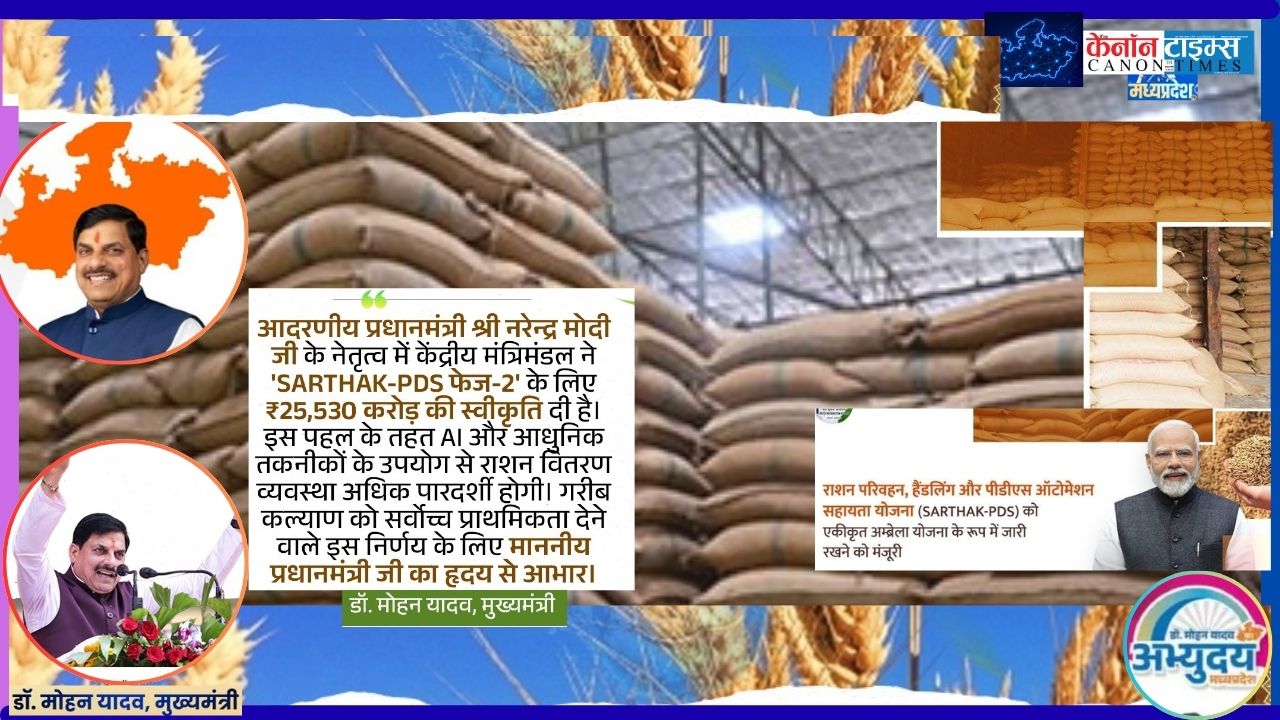
Chief Minister Mohan Yadav welcomed the approval of the scheme and expressed gratitude to Prime Minister Narendra Modi for prioritizing poor welfare through technology enabled reforms. The programme, aimed at strengthening automation in the Public Distribution System, seeks to modernize ration transportation, management, and beneficiary services with the help of Artificial Intelligence and digital monitoring systems.
The significance of this initiative goes far beyond administrative modernization. Efficient food distribution is directly linked to social justice and economic security. When welfare systems become transparent and accountable, the benefits reach the intended recipients more effectively.
Over the past decade, India has already witnessed major digital reforms in the Targeted Public Distribution System. Ration card digitization, Aadhaar integration, e POS devices at fair price shops, online allocation systems, and computerized supply chain management have significantly reduced irregularities. Citizen focused platforms such as “Mera Ration,” “Annapurna Mitra,” and digital dashboards have further improved accessibility and monitoring.
The inclusion of Artificial Intelligence in the next phase could strengthen predictive management, detect irregular patterns, optimize supply chains, and improve real time decision making. In a country as large and diverse as India, technology driven governance is increasingly becoming essential for ensuring efficiency and transparency at scale.
At the same time, modernization must remain inclusive. Digital systems should simplify access rather than create barriers for poor households, senior citizens, and rural beneficiaries who may face technological challenges. Infrastructure, connectivity, and awareness at the grassroots level will therefore remain critical to the success of such reforms.
The larger message behind initiatives like Sarthak PDS is that welfare delivery in India is gradually moving from manual administration to smart governance. Technology is no longer limited to urban development or corporate sectors. It is now becoming a powerful tool for social welfare, food security, and inclusive growth.
A transparent and efficient Public Distribution System not only strengthens trust in governance but also ensures that food security reaches every deserving citizen with dignity. The success of such reforms will ultimately depend on balancing technology with accessibility, accountability, and human sensitivity.

Author: This news is edited by: Abhishek Verma, (Editor, CANON TIMES)
Authentic news.