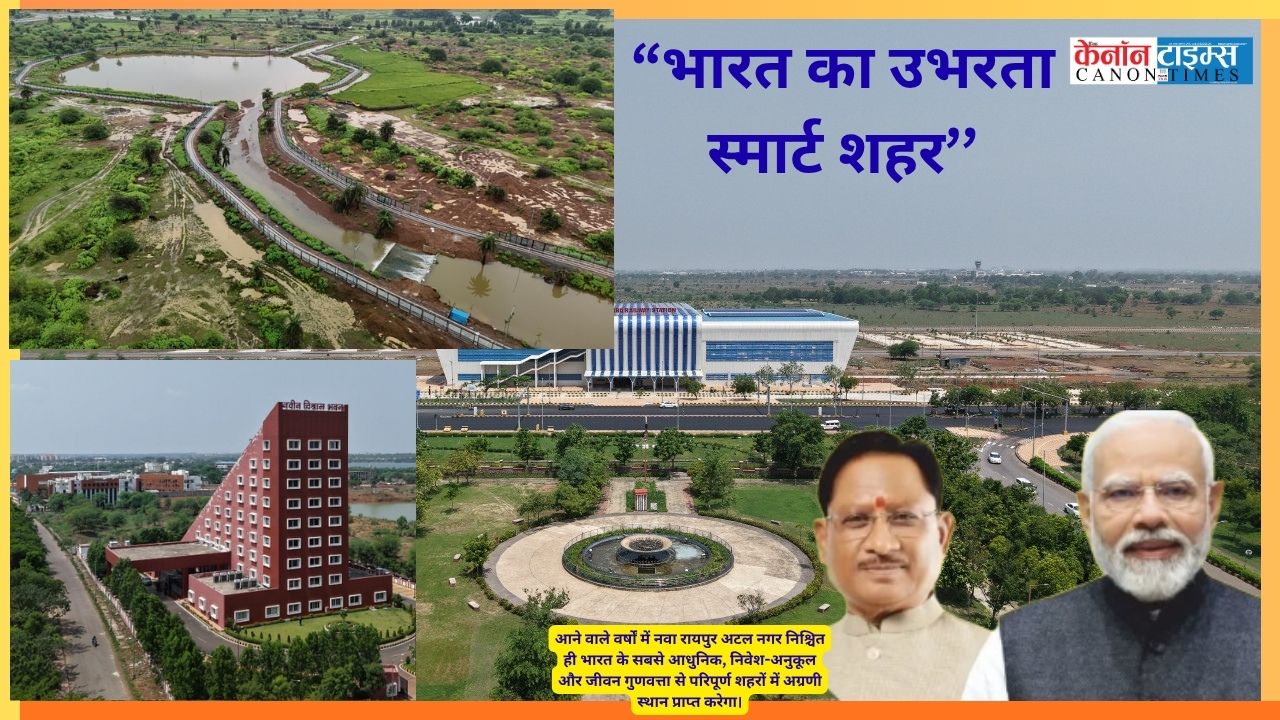
As India rapidly urbanises, the success of its future will increasingly depend on how well its cities are planned, managed, and sustained. In this context, Naya Raipur Atal Nagar represents one of the country’s most ambitious experiments in building a modern, planned, and investment driven urban centre. What was once envisioned as a new administrative capital for Chhattisgarh is now steadily emerging as a model smart city focused on infrastructure, technology, education, healthcare, and sustainable development.
The progress made in Naya Raipur demonstrates how planned urbanisation can avoid many of the problems that continue to burden older Indian cities, such as congestion, unregulated expansion, water shortages, and inadequate public transport. Investments in water management systems, rainwater harvesting, green corridors, and smart urban infrastructure reflect a forward looking approach rarely seen in traditional city planning.

Particularly noteworthy is the city’s emphasis on balanced development. The establishment of Edu City and Medi City shows an attempt to position Naya Raipur not merely as a government hub, but as a centre for knowledge, healthcare, and innovation. The allocation of land to institutions such as NIFT, NIELIT, and the National Forensic Sciences University signals the city’s growing academic importance. Similarly, plans for super speciality hospitals and medical tourism infrastructure could transform it into a regional healthcare destination.
The government’s push to attract semiconductor industries, AI data centres, and IT investment is equally significant. India’s growing digital economy requires new urban centres capable of supporting advanced technology ecosystems. By focusing on electronics manufacturing, plug and play IT infrastructure, and innovation based industries, Naya Raipur is attempting to align itself with the economic priorities of modern India.
Another encouraging aspect is the integration of sustainability into urban planning. Green transport initiatives such as e buses and pink e rickshaws, combined with large scale plantation drives and groundwater recharge systems, reflect an understanding that future cities cannot rely solely on concrete expansion. Environmental resilience must remain central to urban growth.
However, the true test of any smart city lies not only in infrastructure or investment figures, but in inclusivity and livability. Planned capitals across the world have often struggled to create vibrant social ecosystems despite impressive physical infrastructure. Naya Raipur must ensure that development benefits ordinary citizens, including workers, nearby rural communities, and lower income groups, rather than becoming an isolated administrative and corporate enclave.
Affordable housing, public transport accessibility, employment generation, and integration with surrounding villages will determine whether the city evolves into a genuinely inclusive urban model. Equally important will be transparency in land use, environmental protection, and long term maintenance of public infrastructure.
India needs new cities that are efficient, sustainable, and future ready. But it also needs cities that are socially connected and economically inclusive. Naya Raipur Atal Nagar has the potential to become a symbol of that balance if development continues with vision, accountability, and human centred planning.
The city today represents more than a new capital. It represents India’s aspiration to build urban spaces that combine growth, sustainability, innovation, and quality of life in a rapidly changing century.

Author: This news is edited by: Abhishek Verma, (Editor, CANON TIMES)
Authentic news.