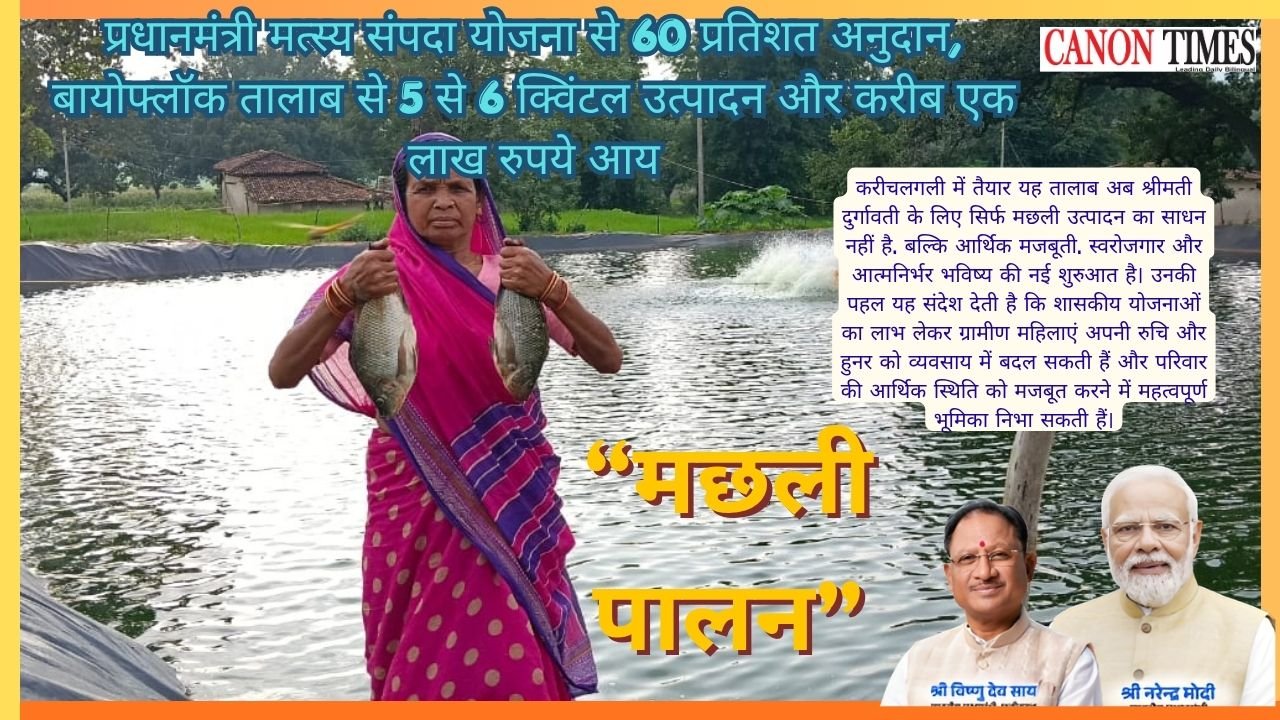
For Durgavati Sirotia of Karichalgali village in Balrampur district, the Pradhan Mantri Matsya Sampada Yojana has turned a long held dream into a working enterprise. She always wanted to start fish farming to raise her family’s income and become self reliant. Capital was the barrier. Then came information about the scheme. She applied. She received a 60 percent subsidy on project cost through the Fisheries Department. She contributed the remaining 40 percent. A biofloc pond was built in 2025 to 2026. Technical guidance was provided. Today, the pond is ready. She expects to produce 5 to 6 quintals of fish and earn about one lakh rupees. For her, this is not just a subsidy. It is a foundation for independence.
This is what livelihood policy should feel like on the ground. It is not just about funds. It is about turning interest into income. Biofloc technology allows high density fish farming in smaller spaces with controlled water quality. It suits households that lack large land holdings but have water access and willingness to learn. The 60 percent subsidy reduces the entry barrier. The 40 percent beneficiary share creates ownership without crushing debt. Technical support ensures that stocking, feeding and disease management are handled properly. When these pieces fit, a hobby becomes a business.

Why does this model work. It is simple, scalable and market linked. Fish demand is steady. Prices are predictable. A well managed pond can produce regular cash flow. When a woman runs the unit, she gains decision making power in the household. She can pay school fees, invest in better inputs and plan for expansion. The state’s role is to provide finance, training and market linkages. The household’s role is to manage daily operations with discipline. Together, they create a viable micro enterprise.
The human impact is the most powerful part of this story. Durgavati says the scheme gave her the chance to do what she always wanted. That sentiment is common among PMMSY beneficiaries. A biofloc pond changes how a household sees itself. It reduces vulnerability. It increases confidence. It allows small investments in education, health and livelihoods that were too risky when income was uncertain.
The real test will be scale and sustainability. Can this model be replicated across more villages. Will training be continuous, not just at the start. Will market linkages be strengthened so that producers get fair prices. Will credit be accessible for expansion. And will environmental safeguards be in place so that water use and discharge are managed responsibly. If these pieces fall into place, PMMSY can become a lasting pillar of rural diversification.
Chhattisgarh is betting that small aquaculture units can change rural incomes. For women like Durgavati, a biofloc pond is not just a water body. It is a pathway to self reliance. That is the true measure of this scheme: not just the number of ponds built, but the businesses launched and the futures secured.

Author: This news is edited by: Abhishek Verma, (Editor, CANON TIMES)
Authentic news.