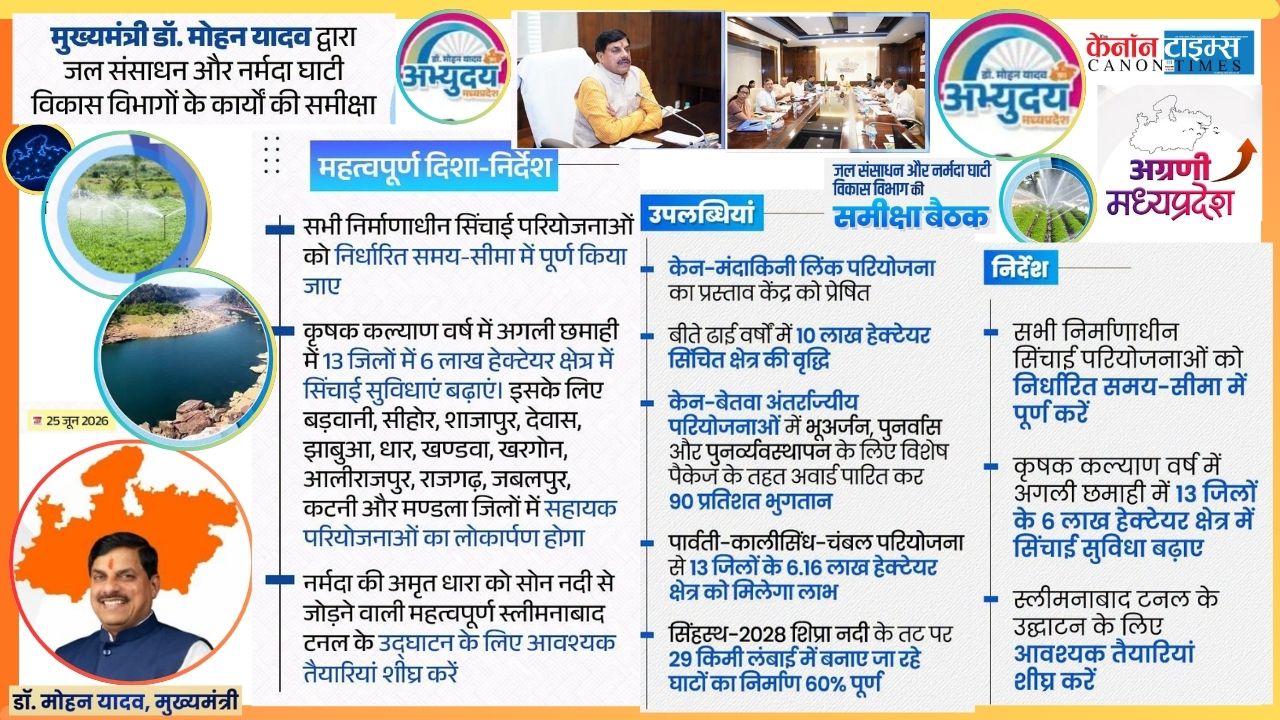
Madhya Pradesh’s journey toward water self reliance under Chief Minister Dr. Mohan Yadav is not being presented merely as an administrative programme. It is being framed as a civilizational commitment, one that treats water as a source of life, faith and social duty.
That framing matters, because water security in India cannot be solved by engineering alone. It requires public belief, political will and everyday participation from citizens, farmers and local institutions.

The state’s emphasis on river restoration, pond revival, rainwater harvesting and groundwater recharge reflects a broader understanding that water is the foundation of development.
If villages, towns and cities are to grow without deepening scarcity, then conservation must become routine rather than exceptional. In that sense, the expansion of initiatives such as the Jal Ganga Samvardhan campaign and water conservation through public participation is welcome. These are the kinds of efforts that can shift water management from crisis response to long term planning.
The focus on Shipra is especially significant. Rivers in Madhya Pradesh are not only ecological assets but also cultural arteries. The attempt to clean, revive and maintain the flow of Shipra ahead of Simhastha 2028 is therefore more than a pilgrimage related project. It is an effort to reconcile faith, urban planning and environmental responsibility. If successful, it could offer a model for how sacred rivers can be protected without reducing them to symbols alone. The real test, however, will be whether sewage treatment, diversion of polluted flows and restoration of natural systems continue with discipline after the ceremonial moments pass.
The state’s reported progress in water conservation works, farm ponds, recharge structures, check dams and traditional water bodies shows the importance of scale. Small structures, repeated across thousands of locations, can create a large cumulative impact. This is where Madhya Pradesh appears to be building a practical model. When farmers are trained in drip irrigation, sprinklers and low water crops, and when local communities help monitor and maintain water assets, conservation becomes linked to livelihoods rather than treated as an abstract environmental slogan.
There is also a strong policy lesson in the emphasis on public participation. Water programs succeed when they are not seen as solely government led. The idea of jal chowpal, local awareness and collective responsibility can help communities protect common resources more effectively than enforcement alone. This is especially important in a time when climate stress, falling groundwater and erratic rainfall are making water management more urgent across the country.
At the same time, ambition must be matched by transparency and maintenance. Building structures is only the beginning. Their condition, use and long term functionality will determine whether the state truly becomes water secure. Regular audits, local ownership, scientific monitoring and transparent reporting should therefore remain central to the model.
Dr. Yadav’s water campaign has political appeal because it connects devotion, development and administration in one frame. But its deeper value lies elsewhere. If it can leave behind healthier rivers, stronger groundwater, better farm resilience and a culture of conservation, it will matter far beyond any single tenure. That is how a state builds water security not as a slogan, but as a lasting public ethic.

Author: This news is edited by: Abhishek Verma, (Editor, CANON TIMES)
Authentic news.