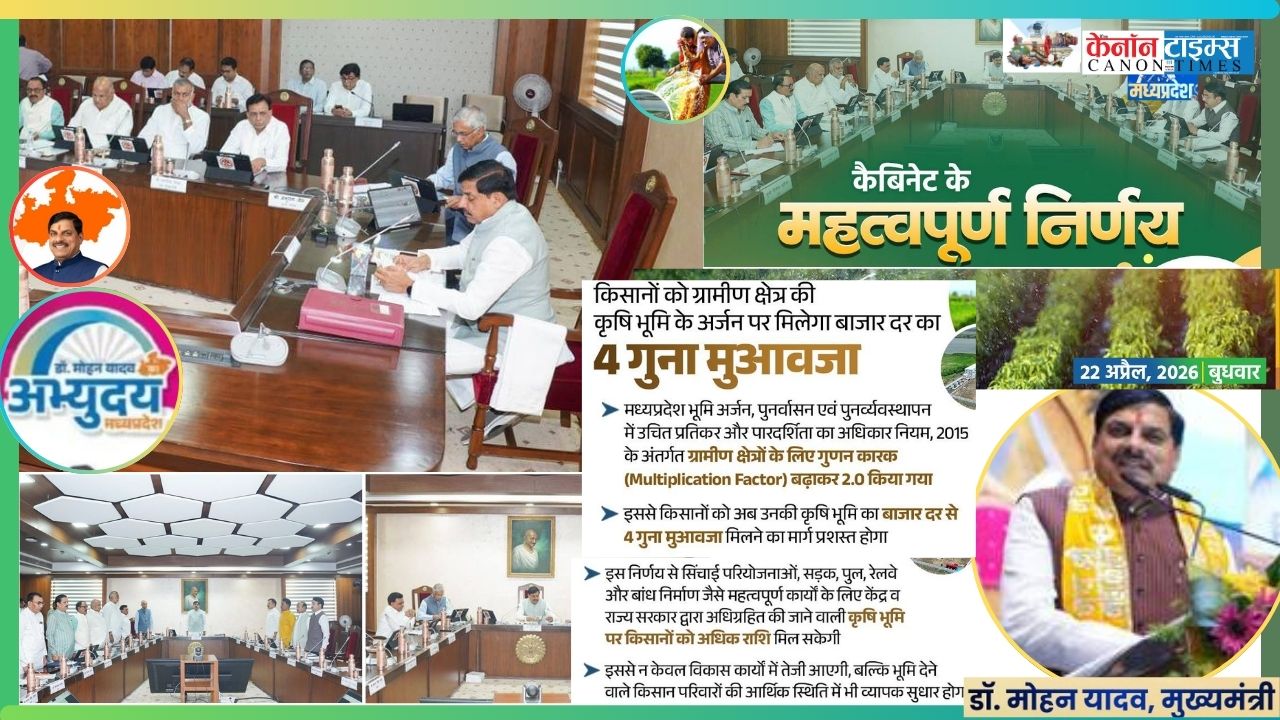
Madhya Pradesh Chief Minister Dr. Mohan Yadav’s cabinet has scripted a bold new chapter in the state’s developmental saga, one that deftly marries the imperatives of progress with the pressing needs of its agrarian backbone. At the heart of Wednesday’s decisions lies a landmark reform of doubling the multiplication factor to 2.0 under the 2015 Land Acquisition Rules for rural agricultural land, catapulting compensation from double to a generous four times the market rate. This isn’t mere arithmetic; however, it’s a clarion call for equity, ensuring that farmers, whose toil sustains the nation, are no longer shortchanged when their fields make way for irrigation canals, soaring highways, sturdy bridges, vital railways, or towering dams. Urban areas retain the existing 1.0 factor, a pragmatic carve out that keeps city centric projects viable without diluting rural relief. Born from a sub committee’s meticulous deliberations led by Ministers Tulsiram Silawat, Rakesh Singh, and Chetan Kashyap, drawing on peer state benchmarks and dialogues with farmer collectives, CREDAI, CII, and FICCI, this move heralds economic renaissance for myriad rural households, infusing development with a human touch long absent in land acquisition narratives.
Yet, this farmer first ethos doesn’t stand in isolation; however, it propels a colossal Rupees 33,985 crore infusion into infrastructure’s lifeblood (irrigation, health, education, and roads) signaling Madhya Pradesh’s unyielding march toward self reliance. Picture the Indoukh Rudaheda micro irrigation project in Ujjain’s Jharada tehsil, now backed by Rupees 157.14 crore to quench 10,800 hectares across 35 villages, turning parched earth into verdant promise. Or the Chhindwara Irrigation Complex, fortified with Rupees 969 crore rehabilitation package escalated from Rupees 840.80 crore and benchmarked against the Ken Betwa paradigm, unleashing four dams to irrigate 190,500 hectares in Chhindwara and Pandhurna, uplifting 628 villages in a cascade of prosperity. Public Works claims Rupees 25,164 crore, a war chest for uninterrupted road building through the MP Road Development Corporation till 2031 (Rupees 7,212 crore), rural connectivity (Rupees 6,150 crore), bridge modernizations (Rupees 1,087 crore), asset upkeep (Rupees 765 crore), and mega bridges under the 16th Finance Commission (Rupees 9,950 crore), weaving a seamless web of mobility.

No less visionary are the strides in human capital. Education’s lifeline, the free bicycle scheme (2004-2005) vintage triumph aiding rural Class 6 and 9 students trekking to distant schools sans local options; secures Rupees 2,190.44 crore through 2030 to 2031 (Rupees 990 crore for bikes, Rupees 1,200.44 crore for teacher training and upgrades), democratizing access in a state where every pedal stroke defies dropout destinies. Health’s renaissance draws Rupees 5,479 crore, with CM CARE 2025 commandeering Rupees 3,628 crore over five years to pioneer oncology, cardiology, cardiac surgery, and transplants in medical colleges via public private alchemy, Rupees 1,503 crore for facility expansions and a recalibrated Rupees 347.39 crore for Mandla’s nascent medical college, overcoming site hurdles. Philanthropic hostels for patient kin in key colleges, fee regulated, zero state outlay, promise sanitized sanctuaries, easing hospital burdens and restoring dignity to the distressed.
Administrative fine tuning crowns this tableau (15 posts) for the Sixth State Finance Commission and Rupees 24 crore for the Chief Minister Young Professional programme’s third phase, entrusting the Public Service Management Department with its execution. In sum, Dr. Mohan Yadav’s cabinet has forged a blueprint where farmer fortunes fuel holistic upliftment, proving that true governance thrives at the intersection of compassion and ambition (a template) for India’s hinterlands to emulate.

Author: This news is edited by: Abhishek Verma, (Editor, CANON TIMES)
Authentic news.