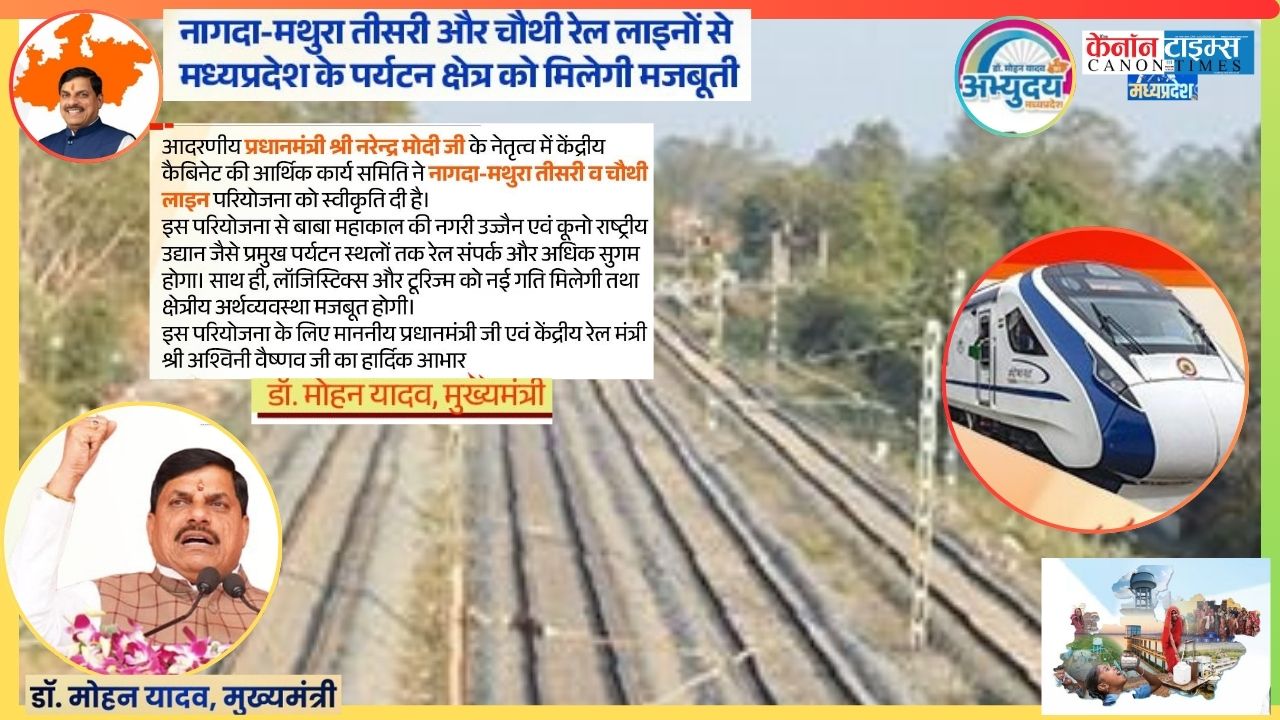
Infrastructure projects often gain attention for their scale and investment value, but their real significance lies in how they reshape regional economies and improve connectivity. The approval of the third and fourth rail lines on the Nagda-Mathura route is one such development that could have long-term implications for Madhya Pradesh and neighboring states.
The project, approved under the PM Gati Shakti National Master Plan, is more than a railway expansion exercise. It represents an attempt to strengthen the backbone of transportation in one of India’s strategically important corridors. With increasing passenger and freight traffic on existing routes, capacity enhancement has become essential rather than optional.

One of the most immediate benefits will be improved access to major tourism destinations such as Ujjain, home to the revered Mahakaleshwar Jyotirlinga, and Kuno National Park, which has emerged as an important wildlife tourism destination. Better rail connectivity can significantly enhance tourist movement, reduce travel delays and support local businesses dependent on hospitality and pilgrimage tourism.
The importance of rail infrastructure in tourism is often underestimated. Efficient connectivity does not merely transport visitors; it stimulates hotels, restaurants, transport services and local markets. For religious and ecological tourism hubs, reliable rail access can become a major economic driver.
At the same time, the project’s freight potential may prove even more transformative. Improved railway capacity for transporting coal, cement, fertilizers, steel and agricultural products can strengthen supply chains and reduce logistical bottlenecks. In a developing economy, freight efficiency directly affects industrial competitiveness and regional investment potential.
The broader regional impact also deserves attention. The corridor will connect multiple states, including Rajasthan and Uttar Pradesh, thereby improving inter-state trade and mobility. Reduced congestion and increased train speeds are likely to improve both passenger experience and freight reliability.
However, as with most large infrastructure projects, implementation will determine success. Timely completion, land management, environmental safeguards and operational efficiency remain critical challenges. India has often announced ambitious infrastructure projects, but delays and cost escalations have weakened outcomes in the past. Maintaining execution discipline will therefore be essential.
There is also an opportunity to integrate this rail expansion with wider regional planning. Tourism circuits, industrial zones and urban growth corridors should evolve alongside transport infrastructure rather than in isolation. Projects like these deliver maximum value when they become part of a coordinated economic strategy.
The Nagda-Mathura rail expansion reflects a larger shift in India’s development priorities, where connectivity is increasingly viewed as a catalyst for economic transformation. If executed effectively, the project can strengthen tourism, boost logistics and deepen regional integration across central and northern India.
Ultimately, railways are not just about tracks and trains. They are about connecting economies, communities and opportunities.

Author: This news is edited by: Abhishek Verma, (Editor, CANON TIMES)
Authentic news.