In Indian culture, rivers are not seen merely as water bodies but as living symbols of faith, civilization, and life itself. Among them, the sacred Ganga holds the highest spiritual significance. Celebrated on the tenth day of the bright fortnight of the Hindu month of Jyeshtha, Ganga Dussehra commemorates the descent of the River Ganga to Earth. Beyond its religious importance, the festival represents humanity’s gratitude toward water, the most essential resource for life.
At a time when climate change, depleting groundwater, and water scarcity are emerging as global concerns, the message of Ganga Dussehra has become more relevant than ever. India’s development journey today increasingly recognizes water conservation as central to economic growth, agriculture, environmental sustainability, and public health.

Under the leadership of Prime Minister Narendra Modi, water conservation has evolved into a nationwide movement. Initiatives such as the Jal Jeevan Mission, Namami Gange, Jal Shakti Abhiyan, and the Amrit Sarovar Mission have transformed the way India approaches water management. These programmes are not merely infrastructure projects. They represent an effort to make water conservation a people’s movement.
The Amrit Sarovar Mission, launched as part of the Azadi Ka Amrit Mahotsav, has emerged as one of the most impactful initiatives. Thousands of water bodies across the country have been restored or newly developed to improve rainwater harvesting, groundwater recharge, and irrigation support. Similarly, the “Catch the Rain” campaign has encouraged citizens to value every drop of rainwater and adopt local conservation practices.
The results are becoming visible. Several regions have reported improved groundwater levels, better irrigation capacity, and reduced dependence on erratic rainfall. More importantly, awareness about responsible water use is gradually becoming part of public consciousness.
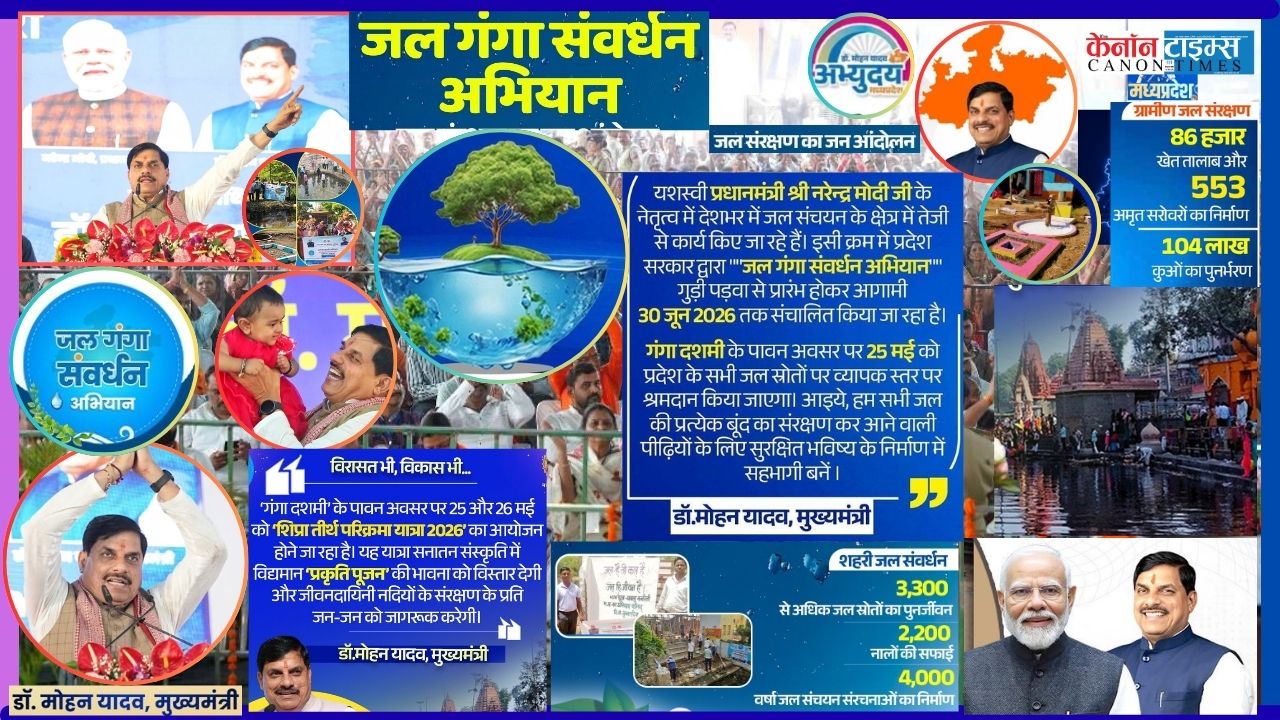
In Madhya Pradesh, the Jal Ganga Sanvardhan Abhiyan has emerged as a remarkable example of community-driven water conservation. The campaign focuses on restoring rivers, ponds, wells, stepwells, and traditional water structures while promoting rainwater harvesting and groundwater recharge. Thousands of check dams, ponds, and water conservation structures are being renovated or constructed across the state with active participation from local communities, youth groups, women, and public representatives.
For an agriculture-dependent state like Madhya Pradesh, such efforts are critical. Water security directly influences crop productivity, rural livelihoods, and economic stability. With unpredictable rainfall patterns and declining groundwater levels becoming major concerns, conservation initiatives are helping farmers secure irrigation and improve agricultural resilience.
Equally significant is the cultural dimension of these efforts. Ancient ponds, baolis, and traditional water systems are not only engineering marvels but also part of India’s civilizational heritage. Their restoration strengthens both environmental sustainability and cultural pride.
Water conservation today is no longer just an environmental issue. It is an economic necessity, a social responsibility, and a national priority. Festivals like Ganga Dussehra remind us that water must not be taken for granted. Respect for rivers and natural resources has always been deeply embedded in Indian traditions, and modern India must carry that wisdom forward through practical action.
The true success of any water conservation campaign depends not only on government policies but also on public participation. Every citizen has a role to play by reducing water wastage, promoting rainwater harvesting, protecting local water bodies, and encouraging sustainable practices.
Ganga Dussehra, therefore, is not just a religious celebration. It is a reminder that safeguarding water means safeguarding life, prosperity, and the future of generations to come.

Author: This news is edited by: Abhishek Verma, (Editor, CANON TIMES)
Authentic news.