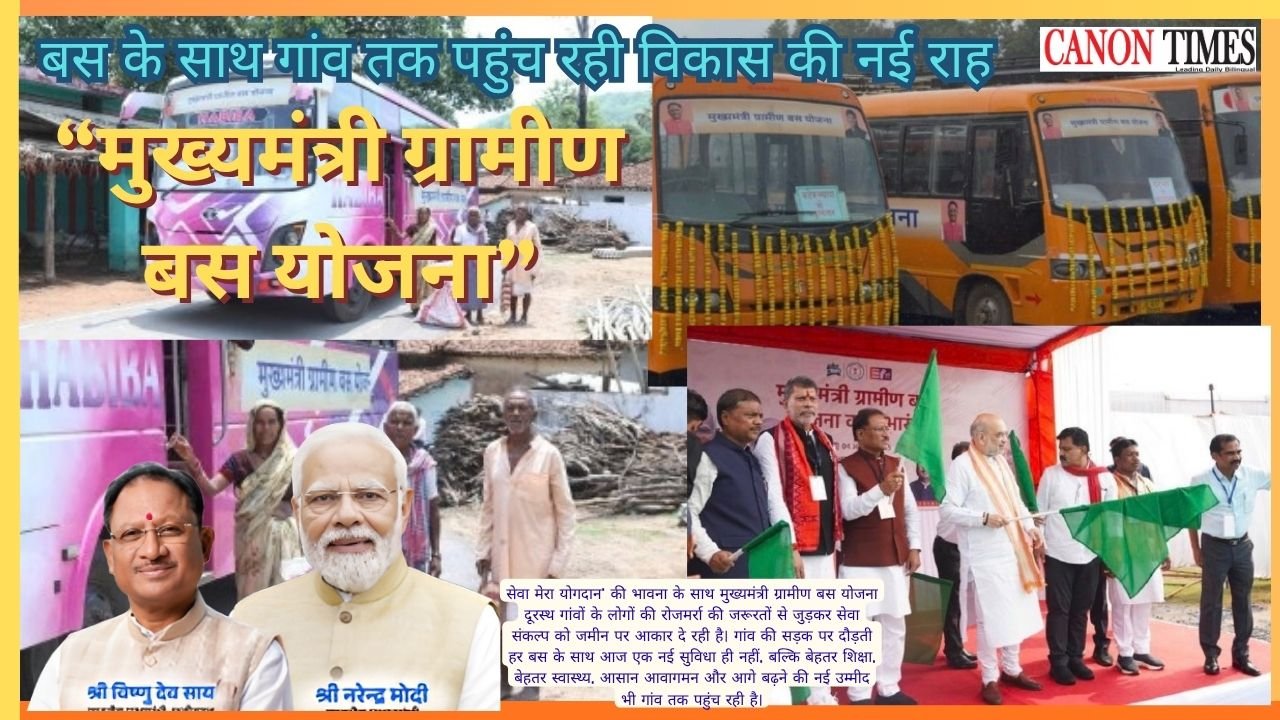
In remote villages of Bastar and Sarguja, the sound of a bus horn now brings smiles. Children wave. Adults relax. For many, this is the first time a regular public bus has entered their lane. The Mukhyamantri Gramin Bus Yojana, launched on 4 October 2025 from Jagdalpur, has completed one year. In its first phase, it covered 13 districts across the two divisions. Today, 107 buses run on 106 selected routes, connecting 850 villages that had no regular passenger service before. In a year, these buses have covered about 24 lakh kilometres, averaging 17,500 kilometres daily. For students, patients, shoppers and office goers, the change is direct. School commutes are more reliable. Hospital visits are less stressful. Market trips are cheaper and faster.
This is more than a transport scheme. It is a bet on connectivity as a public good. A bus link reduces the cost of distance. It lowers the time tax that the poor pay when they must walk or wait for irregular private vehicles. It makes it easier for women to reach work, for children to reach school and for patients to reach clinics. In hilly blocks such as Bagicha in Jashpur, the gain is larger. An anganwadi worker like Sunita Nikunj no longer depends on lifts or long walks to reach her centre. In Sukma and Bijapur, once cut off by terrain and security concerns, buses now reach villages such as Golapalli, Bhejji, Kistaram, Minpa, Chintalnar, Burkapal, Chintagufa, Konta, Puwarti, Jagargunda, Awapalli, Basaguda, Sarkeguda, Pamed, Bhairamgarh and Nelasnar. For these communities, a bus is not just a vehicle. It is a link to the state.
Why does this matter at scale. Rural mobility shapes opportunity. When a student can reach school on time, attendance rises. When a patient can reach a hospital without a long wait, outcomes improve. When a farmer can reach a market with produce, margins rise. When a woman can commute safely, labour force participation grows. The state has made the economics work by subsidising operators on low density routes. In year one, the support is 26 rupees per kilometre, then 24 and 22 in the next two years. Operators also get up to three years of motor vehicle tax exemption. The aim is to keep buses running even when passenger numbers are thin, so that remote habitations are not left out.
The real test will be reliability and safety. Will buses run on schedule even in monsoon when roads turn rough. Will maintenance be timely so that breakdowns do not strand villages for days. Will drivers be trained for hilly terrain and emergency response so that accidents are reduced. Will the Bus Sangwari app and the live tracking portal actually help villagers plan trips, not just display data for officials. Will feedback loops be strong so that routes and timings are adjusted when demand shifts. And will the subsidy be paid on time so that operators do not cut services when cash flow tightens. If these pieces fall into place, the Gramin Bus model can become a template for other states.
For residents, the gain is direct. Less waiting. Lower cost. More certainty. That is the true measure of this push: not just the kilometres logged, but the commutes improved and the opportunities opened.

Author: This news is edited by: Abhishek Verma, (Editor, CANON TIMES)
Authentic news.