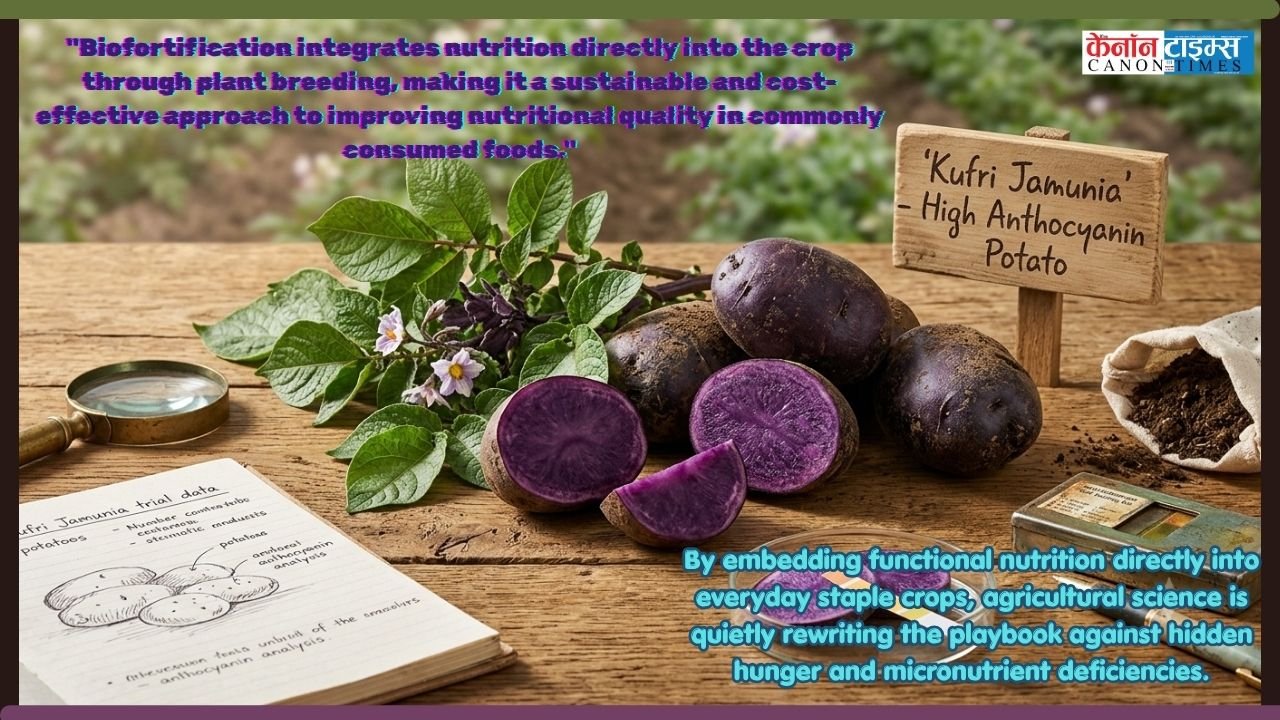
By embedding functional nutrition directly into everyday staple crops, agricultural science is quietly rewriting the playbook against hidden hunger and micronutrient deficiencies.
For decades, India’s agricultural paradigm was anchored in a monumental triumph: achieving national food security through sheer volume. Surpluses in grain production saved millions from starvation and established self-reliance. Yet, as our contemporary public health landscape reveals, simply filling plates is no longer synonymous with nourishing bodies.

The silent crisis of “hidden hunger” the chronic deficiency of essential vitamins and minerals despite adequate caloric intake remains a formidable barrier to national development. It erodes cognitive potential in children, impairs workforce productivity, and deepens generational vulnerability. Traditional food fortification often adds nutrients during industrial processing, bypassing millions in rural and marginalized communities who rely on whole foods. The truly sustainable answer lies upstream, embedded directly within the crops themselves through biofortification.
“Biofortification integrates nutrition directly into the crop through plant breeding, making it a sustainable and cost-effective approach to improving nutritional quality in commonly consumed foods.”
A shining beacon in this quiet agricultural revolution is the Indian Council of Agricultural Research-Central Potato Research Institute (ICAR-CPRI), which has pioneered nutrient-rich, colored potato varieties. From the purple-skinned Kufri Neelkanth and deep-red Kufri Manik to the crowning achievement of 2024, Kufri Jamunia, science is successfully transforming an ordinary staple into a functional superfood.
Kufri Jamunia is a masterclass in agronomic and nutritional synergy. With its striking dark purple skin and vibrant purple flesh, it packs an extraordinary punch: soaring levels of anthocyanins (powerful antioxidants), elevated Vitamin C, carotenoids, alongside essential micronutrients like iron and zinc. Outperforming conventional yellow skinned potatoes by substantial margins nearly doubling Vitamin C and multiplying iron and zinc content it addresses micronutrient gaps at their very root.
Cultivating Resilience and Strong Market Appeal
A biofortified crop remains a theoretical marvel unless it wins over both the farmer who sows it and the consumer who eats it. Here, Kufri Jamunia excels. Boasting impressive station trial yields of up to 49 tonnes per hectare, stable multi-location performance across the North Indian plains, and robust storage qualities with low rottage and minimal weight loss, it offers reliable economic returns for cultivators.
On the culinary front, its mealy texture, pleasant flavor, and deep pigmentation lend themselves effortlessly to everything from traditional curries, parathas, puris, and raita to modern breakfast preparations like daliya, halwa, upma, dosa, and idli batter, as well as processed goods like bakery items and cookies. By bringing both visual novelty and nutritional density to the table, it bridges the gap between health and culinary heritage.
The Road Ahead for Dietary Diversity
Tackling hidden hunger requires a multi-pronged strategy where agriculture, public health, and policy converge. As India looks toward a healthier, more resilient future, the large-scale propagation of biofortified staples like Kufri Jamunia must be integrated into national nutrition programs, school feeding initiatives, and public distribution networks.
By championing innovations that look beyond mere calories, India has the profound opportunity to nourish its populace from the soil up. Kufri Jamunia is more than a purple potato; it is a powerful symbol of how agricultural science can successfully merge high productivity with profound public health impact.

Author: This news is edited by: Abhishek Verma, (Editor, CANON TIMES)
Authentic news.