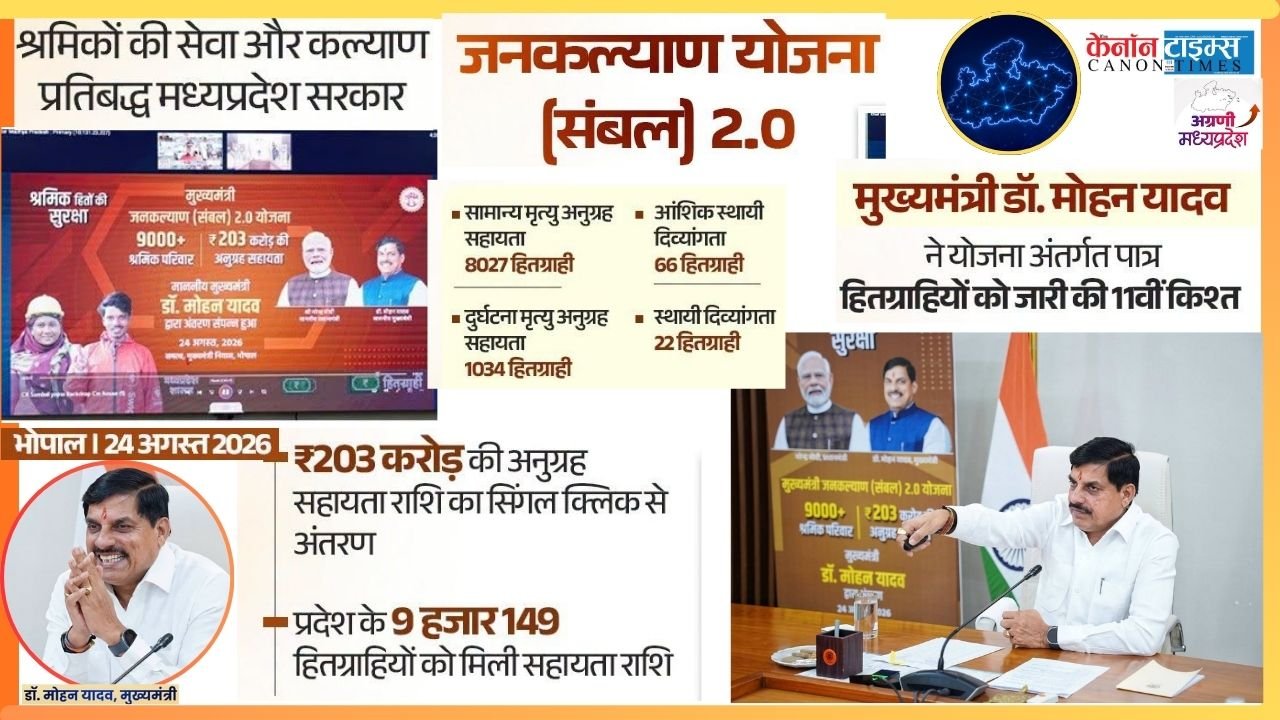
Just before Raksha Bandhan, on the last Shravan Monday, Chief Minister Dr Mohan Yadav released the 11th instalment of the Mukhyamantri Jan Kalyan (Sambal) 2.0 scheme. In a single click, 203 crore rupees were transferred to the accounts of 9,149 eligible workers across Madhya Pradesh. For families facing the sudden loss of a breadwinner, a serious accident or a disabling injury, this money is more than relief. It is a signal that the state will not walk away when life turns harsh.
The numbers tell part of the story. Over 1.84 crore workers have been supported under Sambal since its launch. The latest tranche includes 8,027 beneficiaries for normal death assistance, 1,034 for accidental death, 66 for partial permanent disability and 22 for permanent disability. The scheme provides five thousand rupees for funeral support, two lakh rupees for normal death, four lakh for accidental death, one lakh for partial permanent disability and two lakh for permanent disability. For a labourer’s household, these sums can mean the difference between falling into debt and staying afloat.
Dr Yadav’s message was direct. Workers lay the foundation of a developed Madhya Pradesh, brick by brick, with their sweat and toil. When trouble strikes, many may leave, but the government must not. That is why the state is clearing backlogs and ensuring uninterrupted payments across departments, including labour. The timing matters. A payment before a festival does not just ease expenses. It restores a sense of dignity and hope.
What sets Sambal 2.0 apart is its expanding reach. Gig and platform workers, who earn through apps and online marketplaces, are now included. This recognises a new reality of work. Young people are finding jobs on digital platforms, and their social security cannot be an afterthought. The scheme also links beneficiaries to Ayushman Bharat Niramayam for health coverage, supports fee payments for children studying in medical, law, engineering and polytechnic courses, and provides sixteen thousand rupees to pregnant women workers for better nutrition and care. If a worker becomes temporarily disabled, one lakh rupees is provided. For permanent disability, the support is two lakh rupees.
The government has also moved on labour rights. Madhya Pradesh was the first state to implement the Shram Shakti Samhita. A Shram Star Rating system has been introduced to ensure that worker safety and dignity are not compromised. The Shramana scheme aims to connect workers to cooperatives and build self reliance through skill and collective action. These steps show a shift from ad hoc welfare to a more structured ecosystem of protection and opportunity.
The real test will be execution. Payments must remain timely. Eligibility must be clear. Grievance redressal must be swift. And awareness must reach every worker, especially in informal sectors where information gaps are widest. If these conditions are met, Sambal can become a steady shield for the state’s most vulnerable earners.
A worker’s greatest fear is not just low wages. It is uncertainty. Will my family survive if I fall ill. Will my child’s education stop if I am injured. Will my funeral costs push my household into a cycle of debt. Sambal 2.0 answers these fears with concrete support. That is the true measure of a welfare scheme: not just the money it gives, but the confidence it creates.

Author: This news is edited by: Abhishek Verma, (Editor, CANON TIMES)
Authentic news.