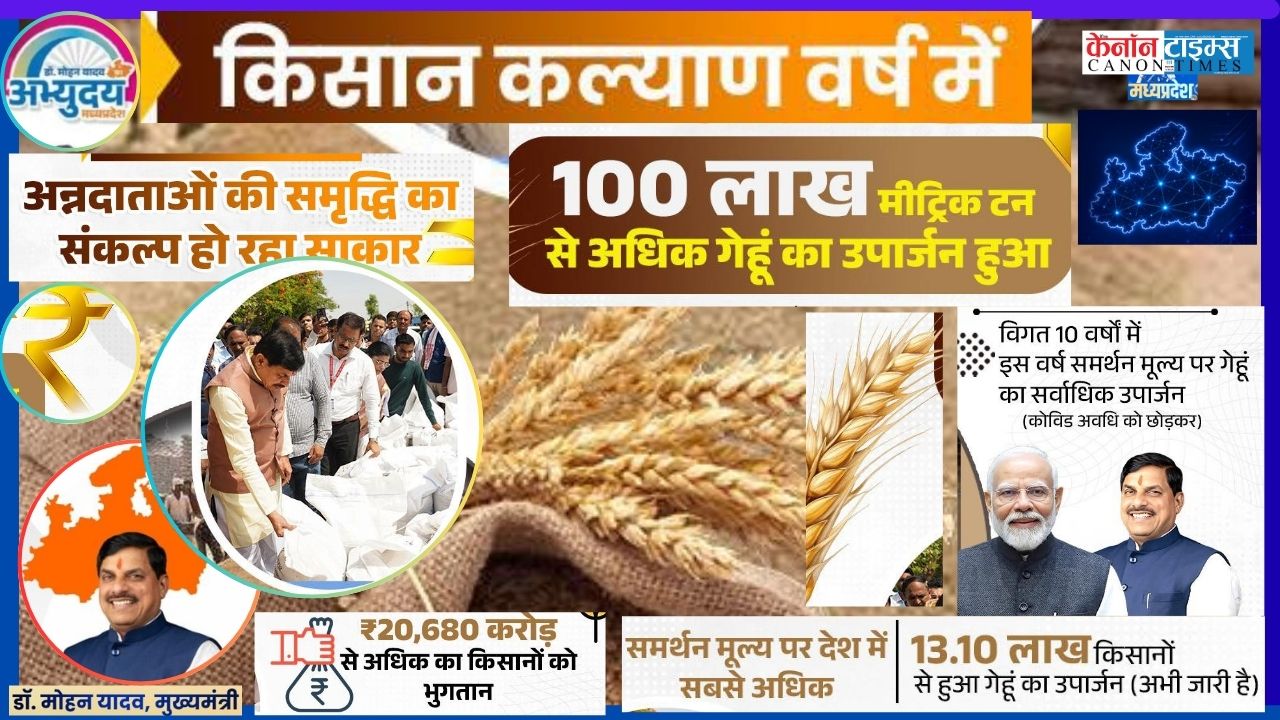
Madhya Pradesh has once again emerged as one of India’s leading agricultural states, recording a major achievement in wheat procurement during the current rabi marketing season. With more than 13.10 lakh farmers selling wheat at the Minimum Support Price (MSP), the state has become the highest in the country in terms of the number of farmers benefiting from government procurement. At the same time, procurement has crossed 100 lakh metric tonnes, placing Madhya Pradesh second only to Punjab in total wheat procurement.
This achievement is more than just a statistical milestone. It reflects the growing integration of farmers into institutional procurement systems and demonstrates the importance of effective state support in ensuring agricultural stability and rural income security.

The state government’s decision to procure wheat at Rupees 2,625 per quintal, including a Rupees 40 bonus over the MSP, has provided farmers with a strong financial incentive and helped strengthen confidence in the procurement process. Timely payments worth more than Rupees 20,680 crore have further reinforced trust among farmers, many of whom depend on assured procurement for economic stability.
One of the most significant aspects of this year’s procurement drive has been administrative efficiency. Procurement centers were equipped with additional weighing machines, improved storage arrangements, extended operational hours, and better public facilities such as drinking water and shaded waiting areas. The extension of procurement dates for farmers who had already booked slots also showed flexibility and responsiveness toward farmer concerns.
Such improvements may appear administrative on the surface, but they have a direct impact on the lives of farmers. Delays in procurement, inadequate infrastructure, or slow payments often force farmers into distress sales at lower market prices. By addressing these operational gaps, the state has made the procurement system more accessible and reliable.
The achievement is also politically and economically significant because agriculture remains the backbone of Madhya Pradesh’s economy. Large-scale procurement not only supports farmers but also contributes to national food security. In a period marked by climate uncertainty and rising production costs, assured procurement acts as a stabilizing mechanism for rural India.
However, the success of procurement should also encourage a broader discussion on agricultural sustainability. While wheat procurement offers immediate income support, long-term agricultural resilience will require diversification, investment in irrigation efficiency, crop value addition, food processing, and climate-resilient farming practices. States like Madhya Pradesh must now focus equally on storage infrastructure, supply chains, and reducing post-harvest losses.
Another important challenge is balancing procurement growth with ecological concerns. Excessive dependence on water-intensive crops can create pressure on groundwater resources over time. Policymakers must therefore ensure that procurement incentives are aligned with sustainable agricultural planning.
Still, the current achievement deserves recognition. The scale at which Madhya Pradesh has managed procurement, farmer participation, and timely payments reflects administrative coordination and policy commitment. It also highlights how state intervention, when implemented effectively, can provide economic confidence to millions of farming families.
The larger message is clear: agriculture succeeds not only through production, but through systems that guarantee farmers fair prices, timely support, and dignity for their labor. Madhya Pradesh’s wheat procurement drive offers an example of how governance can strengthen that trust between the state and the farmer.

Author: This news is edited by: Abhishek Verma, (Editor, CANON TIMES)
Authentic news.