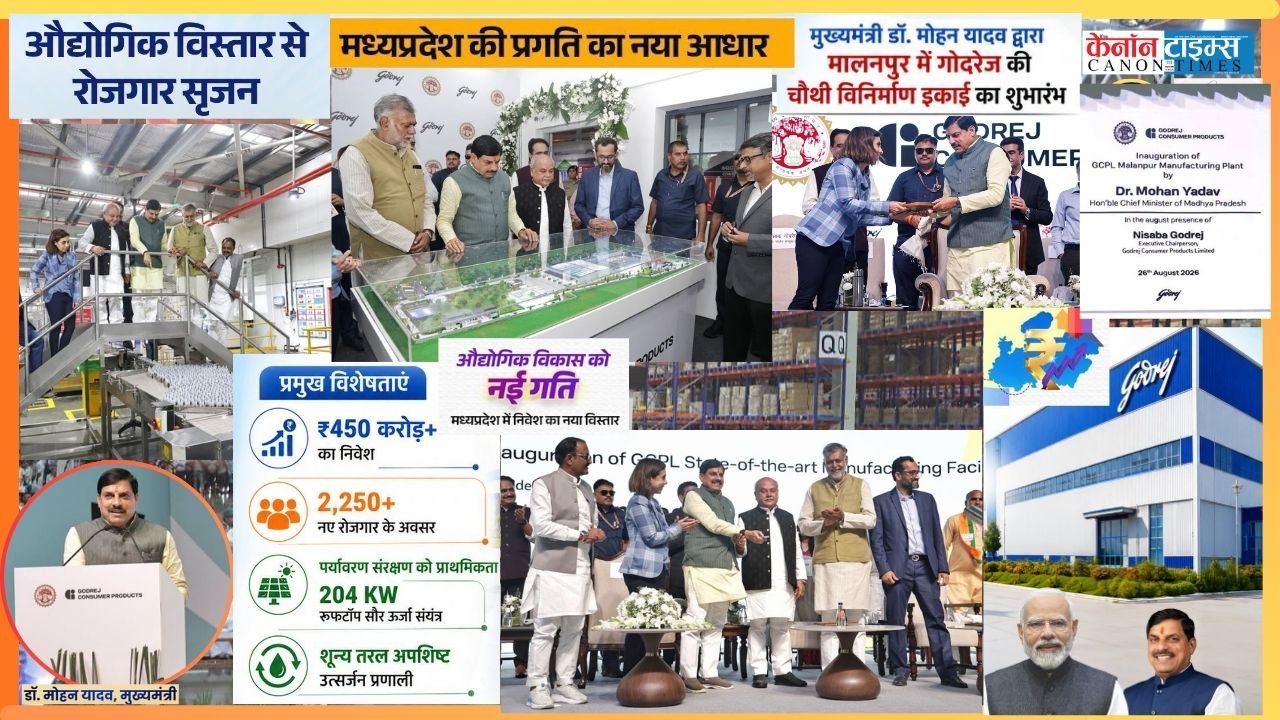
Chief Minister Dr Mohan Yadav inaugurated Godrej Consumer Products’ fourth integrated manufacturing unit in Malanpur, Bhind district. The company is investing an additional 450 crore rupees, creating direct employment for over 600 people. The plant will make Malanpur home to Asia’s largest integrated soap bar manufacturing facility, capable of producing up to 4,000 bars a minute. For a region once labelled a lawless belt, this is more than a factory opening. It is a statement that Chambal is rewriting its identity.
The numbers tell part of the story. Godrej’s total investment in Malanpur since 1991 now stands at about 850 crore rupees across multiple units. The new facility, built with advanced automation and digitisation, is expected to generate a turnover of 3,800 crore rupees once fully operational. Employment at the site will rise from 2,200 to 2,800. The company’s leadership called Malanpur the heart of its manufacturing network. The Chief Minister called it proof of “Made in MP” and “Faith in MP”. Both are right. A 35 year partnership between a private group and a state does not survive on sentiment. It survives on trust, policy stability and shared gains.

Why does this matter for Chambal. The region is seeing a cluster of projects in a short span. In the last two months alone, a 1,500 crore rupee cement plant in Guna, a defence manufacturing unit in Shivpuri and now the Godrej expansion in Malanpur have been launched. A hydrogen plant is also in the pipeline for Bhind. The government says over 30 percent of investment proposals from the Global Investors Summit 2025 have already hit the ground, with nearly 10 lakh crore rupee worth of industrial units taking shape. Madhya Pradesh’s exports have risen to about 76,000 crore rupees. The state claims the lowest unemployment rate in the country and the fastest industrial growth. Whether every metric holds up will be tested over time. But the direction is clear. Investment is flowing, and jobs are being created.
The social impact is as important as the economic one. Godrej’s executive chairperson Nisaba Godrej highlighted the role of women in the plant and welcomed the state’s steps to enable night shifts for women with safety and housing support. This opens doors for more women in manufacturing, not just in routine roles but in skill and leadership positions. The company also noted its readiness to work with the state on malaria control, aligning private product innovation with public health goals. When a factory becomes a partner in community well being, it embeds itself more deeply in the region’s future.
The government’s broader push adds context. Regional industry conclaves have mapped possibilities across the state. A Telecom Manufacturing Zone is planned for Gwalior. Industrial parks are being developed across the Chambal division. A Sainik School has been established, and local mustard processing units in Morena are being complemented by larger manufacturing projects. The aim is to move beyond isolated units to ecosystems where suppliers, logistics and skill development grow together.
What will determine long term success is execution and inclusion. Projects must be completed on time. Land, power and water must be reliable. Compliance should be simple and transparent. Local youth must be trained and hired, not just brought in from outside. And environmental safeguards must be real, not just on paper. If Malanpur can become a model of clean, efficient and inclusive manufacturing, it will attract more investors and raise living standards across the region.
Chambal’s past is well known. Its future is being written now, on factory floors and in skill centres. A soap bar made in Malanpur will travel to homes across India and beyond. But the bigger story is at home. It is in the pay slips of 600 new workers, in the skills gained by local youth, and in the confidence of a region that once feared investment but now courts it. That is the true measure of industrial progress: not just capacity added, but lives changed.

Author: This news is edited by: Abhishek Verma, (Editor, CANON TIMES)
Authentic news.