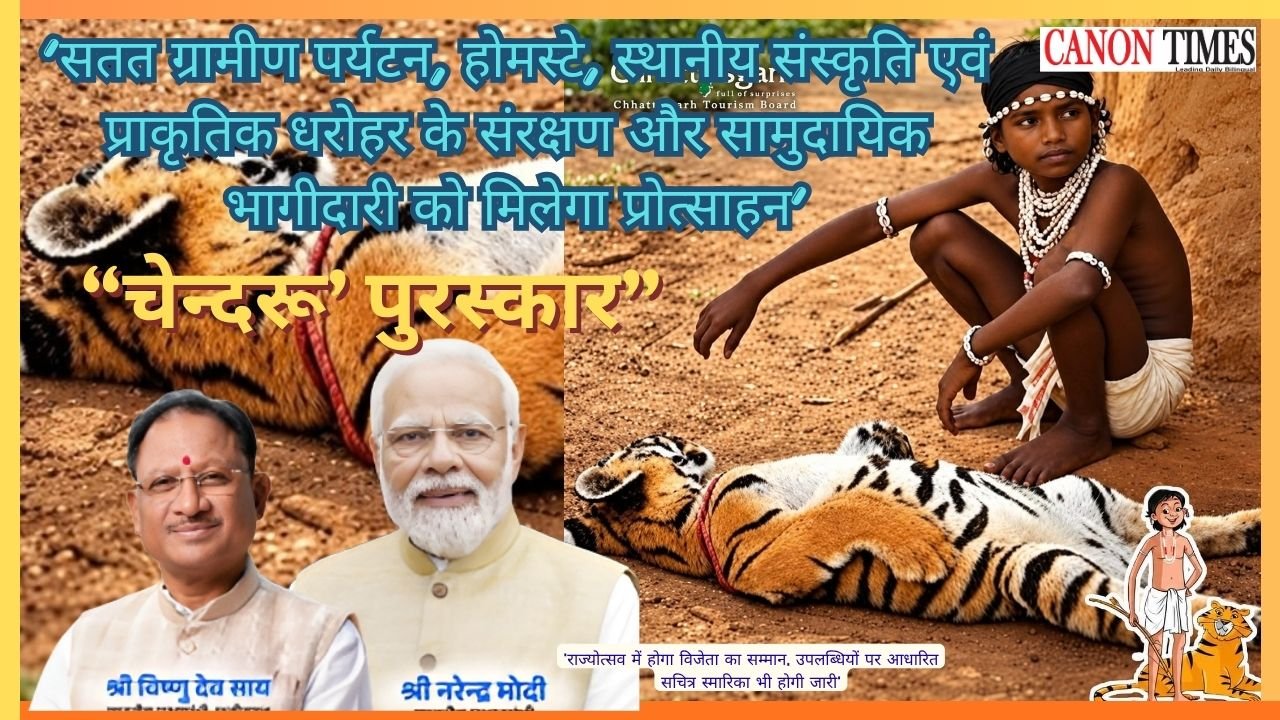
Chhattisgarh has launched the Chendaru State Rural Tourism Award to recognise individuals and institutions that are transforming villages through tourism. Under the newly notified Chendaru State Rural Tourism Award Rules, 2025, a six member jury will evaluate entries on impact, community participation, job creation and the protection of culture and natural heritage. The winner, selected once in a lifetime, will receive a cash prize of one lakh rupees and a citation at the state foundation day, along with an illustrated souvenir documenting their work. Tourism and Culture Minister Rajesh Agrawal said the award aims to ensure that tourism benefits reach remote rural and tribal areas, not just major sites, and to create livelihoods for youth, women, self help groups, artisans and rural entrepreneurs.
This is more than an award ceremony. It is a bet on community led tourism as a development model. When a village offers homestays, local cuisine, craft demonstrations, folk performances and guided nature walks, visitors stay longer and spend more. Income flows directly to households instead of leaking to intermediaries. Young people find reasons to stay rather than migrate. Women gain agency as hosts, cooks, guides and managers. Traditional skills that were fading find new markets. Natural assets such as forests, waterfalls and caves become sources of pride and protection rather than targets for exploitation.

Why it matters
Rural tourism can decentralise economic activity. It can turn cultural heritage into a living asset rather than a museum exhibit. It can make conservation pay by linking it to visitor experience and local jobs. Chhattisgarh’s diversity, from Bastar and Sarguja’s tribal traditions to rural food, crafts, festivals and landscapes, gives it a strong base. The Chendaru name itself carries historical resonance, recalling the region’s identity on the national stage. By honouring ground level innovators, the state hopes to create a repertoire of replicable models that other villages can adapt.
The real test will be what happens after the applause. Will winners receive handholding to scale their work, such as access to credit, design support, digital marketing and safety audits. Will homestay standards be enforced so that hygiene, fire safety and fair pricing become the norm. Will visitor flows be managed so that popular villages do not tip into overtourism that degrades culture and environment. Will benefits be shared across the community so that a few do not capture most of the gains while others bear the costs. And will the jury process be transparent, with clear criteria and public documentation, so that the award retains credibility year after year.
If these pieces fall into place, Chendaru can become more than a trophy. It can become a catalyst for a statewide network of village enterprises that earn from authenticity, not imitation. For visitors, the promise is a deeper experience. For hosts, it is dignity and income. For the state, it is a tourism map that stretches beyond the usual circuits and roots growth in the countryside. The measure of success will not be the number of applications received, but the number of villages that thrive because tourism chose to walk their paths.

Author: This news is edited by: Abhishek Verma, (Editor, CANON TIMES)
Authentic news.