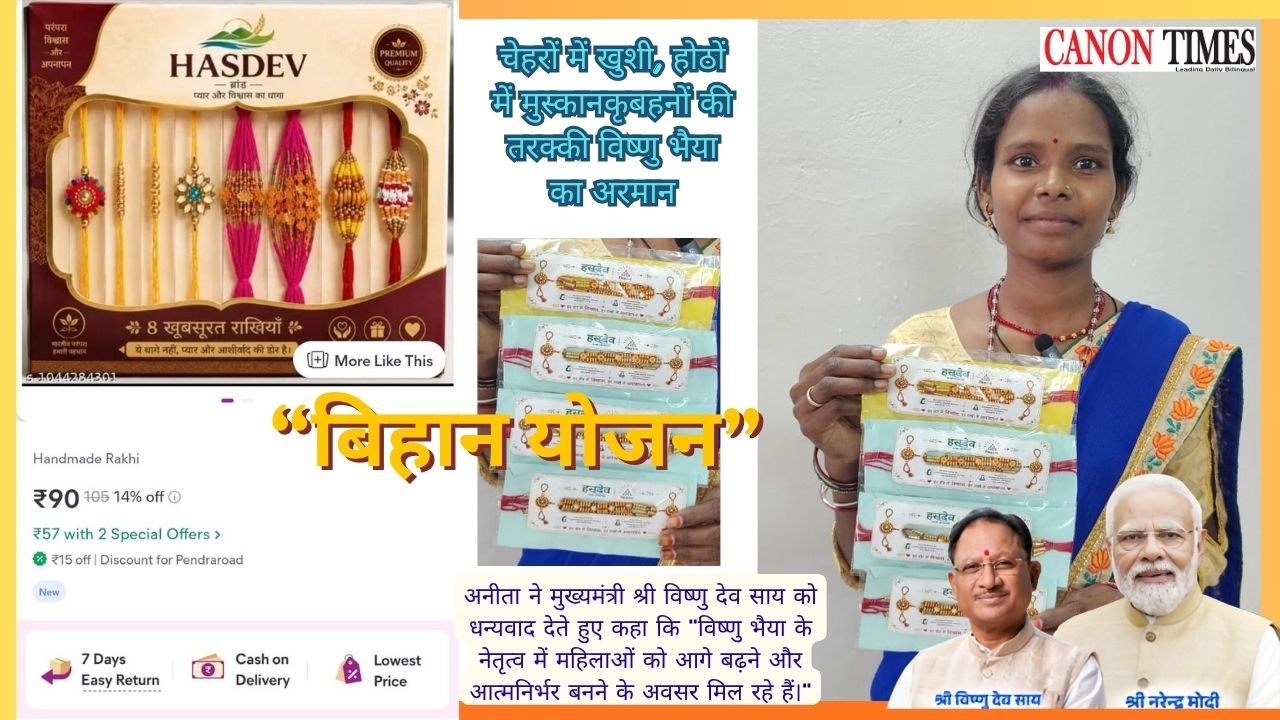
In Chanwaridand village of Manendragarh Chirmiri Bharatpur district, Anita Singh is turning skill into self reliance. Through a self help group linked to the Bihan scheme, she and her fellow women made attractive rakhis for Raksha Bandhan. These are not just festive threads. They carry a brand name, Hasdev, and are being sold in local markets and on online platforms. For Anita, this is more than income. It is a new identity built on her own hands.
She says joining the group boosted her confidence. Alongside household responsibilities, she now earns and contributes. The monthly one thousand rupees from the Mahatari Vandan Yojana added to the festive joy, easing small expenses and allowing the family to celebrate without strain. Anita credits Chief Minister Vishnu Deo Sai, calling him “Vishnu Bhaiya”, and notes that women are finding real chances to move ahead under his leadership. Her story is a snapshot of a larger shift. Across Chhattisgarh, sisters are finding that a small enterprise can change how they are seen at home and in the market.

This is the quiet power of combining skill, collective action and market access. A self help group provides peer support and shared learning. A state scheme like Bihan offers training, tools and linkages. A brand like Hasdev gives a common identity that can command better prices and wider reach. When these pieces fit, a craft stops being a hobby and becomes a livelihood. The rakhi is no longer just a symbol of protection between siblings. It becomes a symbol of economic agency for the woman who makes it.
Critics often ask whether such efforts can scale. One village, one group, one brand may seem small. But the model is replicable. If every block can nurture at least one product with a clear identity, if women can access digital marketplaces with training and logistics support, and if payments remain timely and transparent, the impact can multiply. The state’s role is to keep removing friction: simpler compliance, better packaging support, common facility centres, and faster onboarding to e commerce platforms.
Anita’s smile speaks to what good policy can achieve. It is not just about money. It is about dignity. When a woman earns, she negotiates better within her home. She invests more in her children’s health and education. She becomes a decision maker, not just a caregiver. That is how self reliance grows, one household at a time.
The task ahead is to ensure that Hasdev is not a one off success but a template. More brands, more products, more women. If Chhattisgarh can turn thousands of such stories into a movement, the dream of an Atmanirbhar state will not remain a slogan. It will be visible in the faces of women like Anita, whose craft now carries a name, a market and a future.

Author: This news is edited by: Abhishek Verma, (Editor, CANON TIMES)
Authentic news.