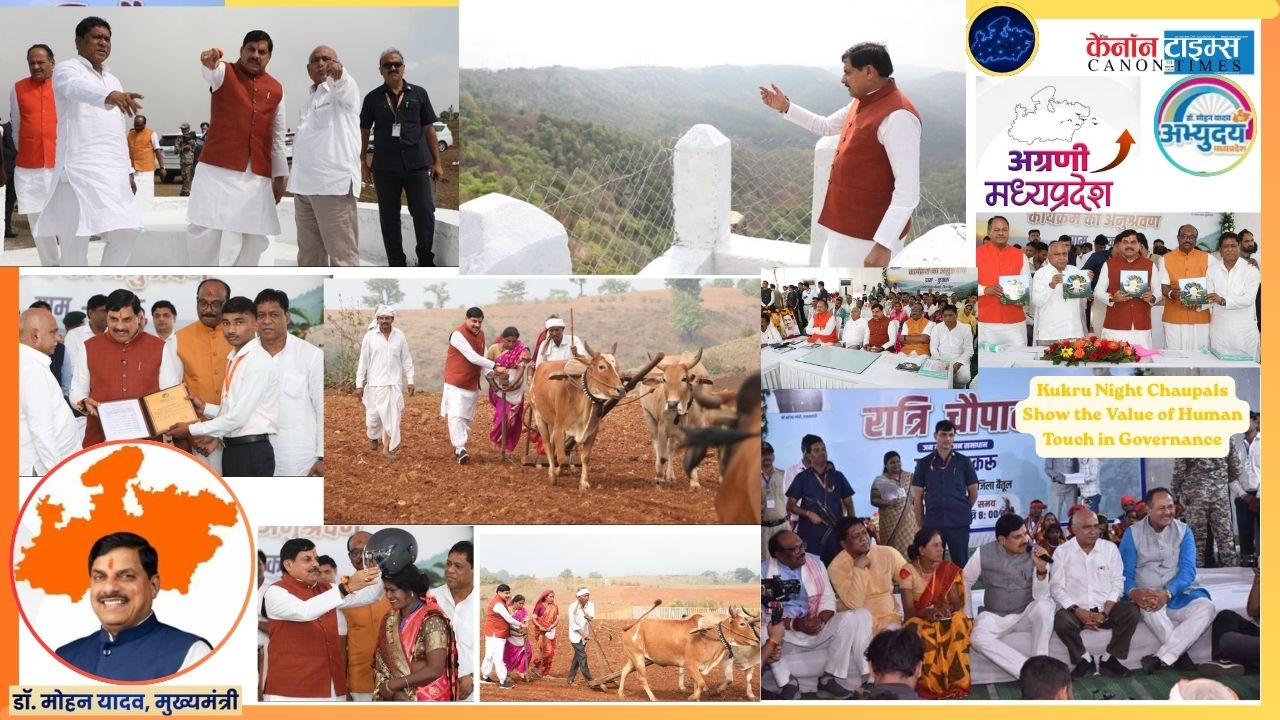
Chief Minister Dr. Mohan Yadav’s night choupal at Kukru in Betul highlights something that many governments struggle to achieve: a sense of direct, personal connection with rural people. In an age when administration often feels distant and procedural, the image of a chief minister sitting among villagers, listening to grievances, sharing songs and responding on the spot, carries political as well as social meaning. It signals that governance can still be approachable, responsive and rooted in everyday life.
What makes the interaction noteworthy is not only the symbolism but the substance. Villagers spoke openly about local problems, from drinking water and roads to school and livelihood needs. The chief minister’s response was not limited to reassurance. He directed immediate action on a pond for drinking water, a girls’ hostel, a road and a culvert, and he asked officials to ensure that eligible farmers are not left out of PM Kisan benefits. Such moments matter because they reduce the gap between complaint and resolution, which is often where public trust is lost.

The emphasis on women’s self help groups is especially important. Dr. Yadav’s push to link these groups with micro and small enterprises reflects a practical understanding of rural development. Women’s collectives can become engines of local income if they are connected to processing units, small manufacturing and livestock related activities. The mention of women who have already become lakhpati didis through such efforts shows that rural enterprise is not a distant dream but a working model when credit, training and markets align.
The focus on livestock and allied farming is equally sensible. By promoting dairy, cattle and buffalo rearing, supporting fodder systems and considering schemes such as Kamdhenu for eligible beneficiaries, the state is acknowledging that farmers need multiple income streams. That is especially relevant in tribal and hill areas where agriculture alone may not guarantee stable earnings. Diversification is not a slogan here; it is a survival strategy that can strengthen household resilience.
There is also a cultural dimension to the event that should not be overlooked. The performance of tribal songs and dances, the exchange of affection, and the informal setting created an atmosphere of mutual respect. Governance becomes more effective when people feel seen, heard and valued. That is particularly true in regions with strong tribal identity, where policy must be accompanied by cultural sensitivity. A government that listens in local idioms is more likely to be trusted than one that only issues orders from afar.
At the same time, the event underlines the expectation that such outreach should lead to durable delivery. Night chaupals are powerful only if they are followed by monitoring, deadlines and visible outcomes. Villagers will judge the administration not by the warmth of one evening but by whether the promised works are completed, the schemes are accessible and the paperwork is cleared without repeated visits. That is where the real test of responsive governance lies.
Dr. Yadav’s visit to Kukru demonstrates the political strength of simplicity. When leaders meet people where they are, speak plainly and act on what they hear, democracy feels more real. If this approach continues to translate into better roads, water, schools, livelihoods and welfare access, it will not just be a successful outreach exercise. It will become a model of governance that combines empathy with execution.

Author: This news is edited by: Abhishek Verma, (Editor, CANON TIMES)
Authentic news.