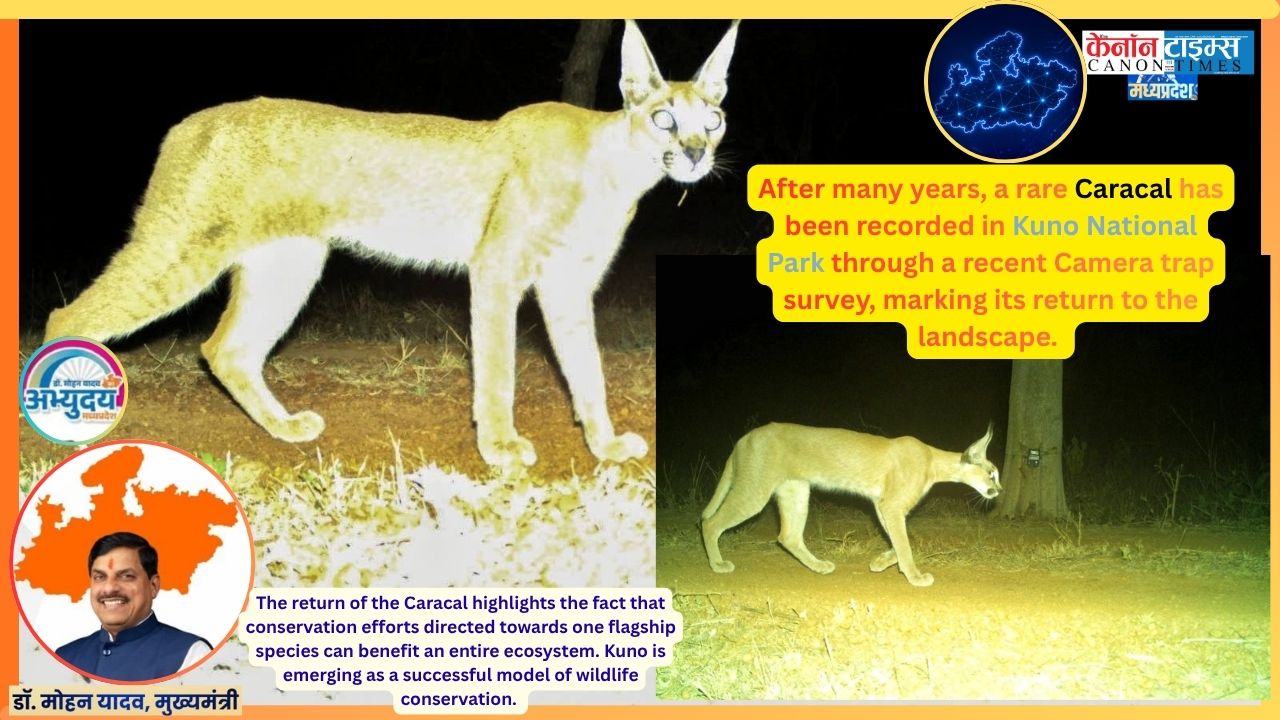
Chief Minister Dr. Mohan Yadav has welcomed an encouraging sign from Kuno National Park: camera trap images confirming the presence of the rare wild cat, the caracal, decades after it was last recorded in the area. This return is more than an isolated sighting. It signals a strengthening ecosystem and validates sustained conservation efforts in the region.
The timing is apt. As the nation marks World Environment Day, the caracal’s reappearance reinforces the link between committed habitat protection and biodiversity recovery. Kuno’s revival points to effective on‑ground management patrolling, habitat restoration and scientific monitoring that create the conditions for sensitive species to reestablish themselves.

Kuno’s progress also reflects larger statewide ambitions. Under Prime Minister Narendra Modi’s guidance, Madhya Pradesh has pursued Project Cheetah to reintroduce a keystone species and restore ecological balance. The project’s goals extend beyond a single flagship animal. They include strengthening entire ecosystems, expanding protected habitats, and improving conditions for rare and threatened fauna. Kuno has become a focal point for these efforts and an example cited both nationally and internationally.
Conservation is not merely about iconic species. The return of a predator such as the caracal shows that prey populations, vegetation and water regimes are improving too. Healthy predator presence indicates a functioning food web, better habitat connectivity and effective human wildlife conflict mitigation. These are the practical yardsticks of successful conservation.
Sustaining momentum will require continued investment in habitat management, community engagement and landscape level planning. Local communities must remain partners in protection through livelihood support, incentive schemes and anti‑poaching cooperation. Science driven monitoring must continue so managers can adapt strategies as conditions change. Finally, replicable lessons from Kuno should inform other protected areas to scale conservation gains across the state.
Kuno’s evolving story is a reminder that thoughtful restoration and vigilant stewardship can restore lost elements of biodiversity. The caracal’s camera trap images are more than a photograph; they are proof that when policy, science and local participation align, nature responds. If Kuno remains this committed model, Madhya Pradesh’s protected areas stand to gain both ecological resilience and global respect.

Author: This news is edited by: Abhishek Verma, (Editor, CANON TIMES)
Authentic news.