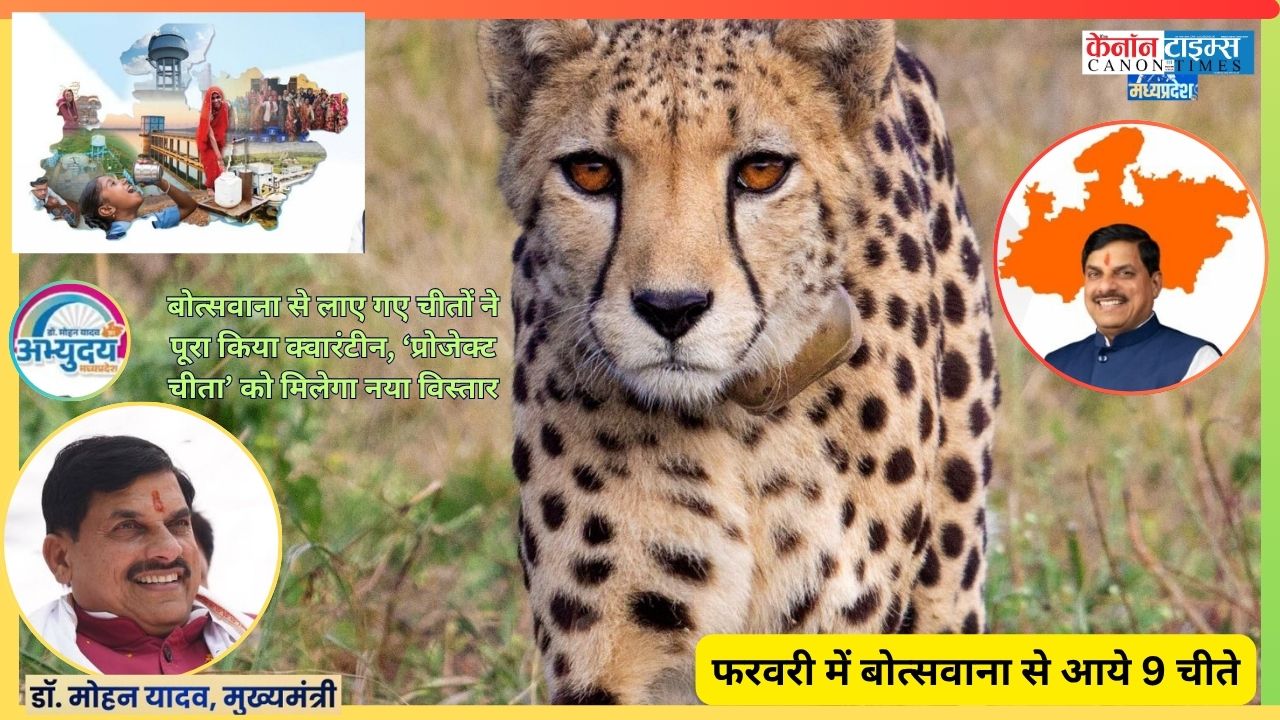
The release of two female cheetahs into the open forests of Kuno National Park marks another important milestone in India’s ambitious wildlife conservation journey. Nearly seven decades after the cheetah was declared extinct in the country, the gradual reintroduction of the species through Project Cheetah represents both ecological restoration and national conservation pride.
The decision to release the Botswana born cheetahs into the wild after successful quarantine and acclimatisation reflects growing confidence in the project’s progress. Since the arrival of the first batch of cheetah’s from Namibia in 2022, followed by South African cheetah’s in 2023 and now Botswana’s contribution in 2026, India has steadily expanded one of the world’s most closely watched wildlife restoration programmes.

The importance of this phase lies not merely in increasing numbers, but in establishing a sustainable and genetically diverse cheetah population capable of surviving independently in Indian forests. Wildlife experts have rightly pointed out that the inclusion of cheetahs from Botswana enhances genetic diversity, a critical factor for the long term health and stability of the species in India. Conservation is not simply about relocating animals; it is about rebuilding ecological balance carefully and scientifically.
Project Cheetah also carries symbolic significance. The extinction of cheetahs in India was widely seen as a reminder of past ecological neglect and uncontrolled hunting. Their return represents a larger shift in India’s environmental priorities, where conservation is increasingly becoming central to national policy and public consciousness. Kuno National Park has now emerged as a global example of species reintroduction and habitat restoration.
However, the project’s long term success cannot be measured through ceremonial releases alone. Reintroducing a top predator into a new ecosystem is a highly complex process involving habitat management, prey availability, disease monitoring, human wildlife conflict prevention, and continuous scientific assessment. Several setbacks in the past, including cheetah deaths and adaptation challenges, have shown that wildlife restoration requires patience, transparency, and sustained institutional commitment.
The expansion plans for Gandhi Sagar and Nauradehi sanctuaries indicate that India is thinking beyond a single site conservation model. This is a positive step, as creating multiple habitats reduces ecological pressure and increases survival chances. At the same time, local communities living near protected areas must become active partners in conservation efforts. Their cooperation and participation will remain essential for reducing conflict and ensuring coexistence.
Project Cheetah is ultimately more than a wildlife programme. It is a test of India’s ability to restore lost biodiversity in a rapidly changing environmental landscape. If managed with scientific discipline and ecological sensitivity, the project can become a landmark achievement in global conservation history.
The sight of cheetahs once again running freely in Indian forests is not merely an environmental success story. It is a reminder that nature, when given protection and time, has the remarkable ability to recover.

Author: This news is edited by: Abhishek Verma, (Editor, CANON TIMES)
Authentic news.