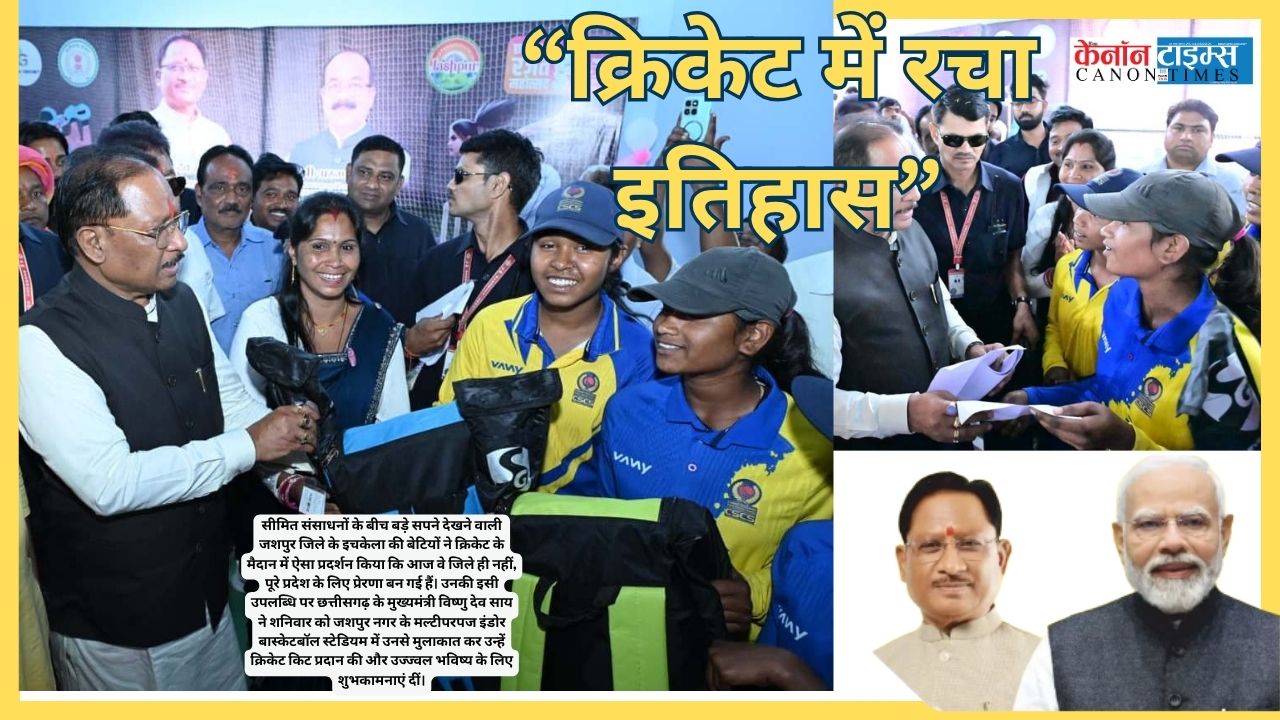
In a district better known for its mineral wealth than sporting culture, a cluster of girls from Ichakela in Jashpur has carved a new legacy on the cricket field. With limited resources, no international standard stadium, and modest facilities, 16 schoolgirls from the Government Pre Matric Hostel for Girls have risen to national recognition, turning their village into a symbol of aspiration for the entire state. Their journey from a makeshift pitch in a remote hamlet to the corridors of sports excellence was recently celebrated when Chhattisgarh Chief Minister Vishnu Dev Sai met the team in Jashpur and presented them with cricket kits, applauding them as beacons of hope for the next generation.
At the heart of this story is the Ichakela MCC, now emerging as a formal cricket academy. From teaching bat and ball basics to girls who once played only for fun, the academy has matured into a structured training ground where 40 students train regularly under coaches Santosh Shankar Soni and Pandari Bai. Their dedication has borne fruit, 17 of these players represent Chhattisgarh in under 17 and under 19 state level tournaments, while others have already tasted inter state and national competition. The academy’s impact was most evident in 2025, when the Sarguja division won the state under 17 cricket title after 25 years, with nine of the 11 players coming from Ichakela. The under 19 contingent followed suit with a silver medal, where eight of the 11 team members were from the same village. Their triumph at the national level inter state tournament in Raigarh further cemented their reputation as a powerhouse of women’s cricket.

What makes this narrative compelling is not just the medals, but the message they carry. These girls embody the idea that passion, when paired with guidance, can overcome the lack of infrastructure, travel funds, or fancy gear. The Chief Minister’s gesture of furnishing them with kits is more than a symbolic act, it is a promise from the state that it will stand as a partner in the arduous climb to excellence. For a region like Sarguja, where educational and economic opportunities remain constrained, the success of these young athletes offers a template for social mobility, the pitch becomes a classroom, discipline replaces privilege, and provincial roots no longer define one’s ceiling.
Ichakela’s daughters have not only scored runs or taken wickets; they have normalized the idea that girls from remote tribal belts belong on big stages. Their story challenges stereotypes about gender, geography, and sporting potential, echoing a broader national shift toward grassroots cricket development. As they prepare for more national tournaments, the state must now translate this moment of recognition into enduring support enhanced coaching, access to tournaments, and pathways to professional contracts. In the long run, the true measure of success will be whether the next batch of girls from Ichakela steps onto the field knowing that their dreams are not a luxury, but the state’s shared responsibility.

Author: This news is edited by: Abhishek Verma, (Editor, CANON TIMES)
Authentic news.