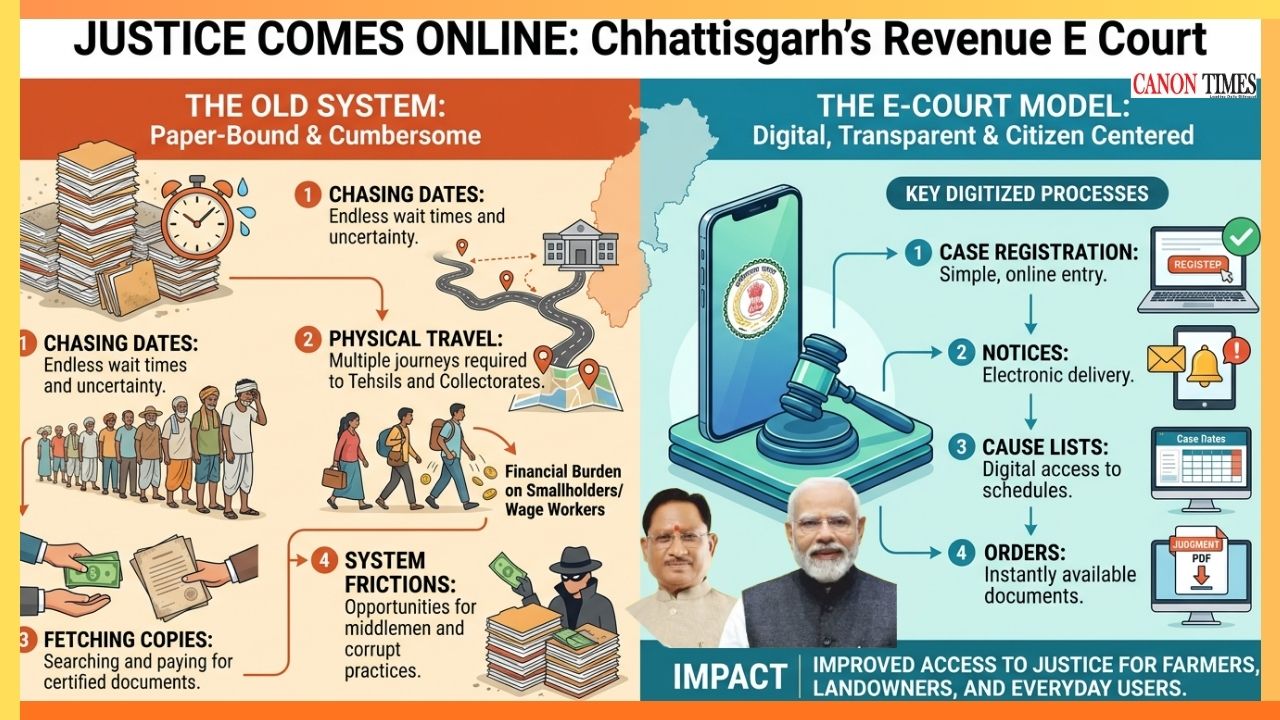
Chhattisgarh’s Revenue E Court: By taking its revenue courts online, Chhattisgarh has done more than deploy another government app.
The state’s revenue e court project has remade an entrenched, paper bound system into a digital, transparent, and citizen centred mechanism that improves access to justice for farmers, landowners and everyday users of the state apparatus.
For decades, revenue litigation in India has exacted a heavy toll in time, money and patience. Citizens had to chase dates, fetch certified copies, and travel to tehsils and collectorates, often multiple times, just to follow a simple procedural step.
Those journeys imposed financial burdens on smallholders and daily wage workers and opened opportunities for middlemen and corrupt practices. By digitising case registration, notices, cause lists and orders, the e court eliminates many of these frictions at a stroke.
The core strength of the project lies in process integrity. Immediate online registration with a digital acknowledgement assures applicants that their petition exists in the official record.
Every subsequent act, notice issuance, service on parties, hearing dates and orders, creates a tamper evident trail. That reduces both deliberate manipulation and inadvertent loss of files, and it strengthens administrative accountability because supervisors can monitor proceedings remotely.
The benefits are especially meaningful for rural citizens. Farmers who once spent a day’s wages to learn a next hearing date can now check the status on a mobile phone or at a local digital service centre.
This saves money, restores time for productive activity, and bolsters trust in the system. Making pending land disputes and case histories publicly viewable before purchase decisions also helps curb fraud and illegal sales, safeguarding property rights and stabilising land markets.
Implementation matters. Chhattisgarh paired the e court rollout with infrastructure upgrades, computers, reliable internet, secure servers and training in revenue courts, so that the technology became usable and durable rather than brittle. That attention to end to end readiness is what turns a digital initiative into lasting reform.
Policymakers often treat e governance as an exercise in automation. Chhattisgarh’s experience shows something subtler: e governance becomes transformative when it is purposeful, user focused and accompanied by managerial oversight. As the state’s leadership rightly insists, technology is worthwhile only when its benefits reach the citizen at the receiving end.
There are, of course, challenges to sustain and scale this success: digital literacy gaps, local language interfaces, offline fallback mechanisms for connectivity outages, and ongoing cybersecurity vigilance. Addressing these will be essential if other states are to replicate Chhattisgarh’s gains without leaving vulnerable groups behind.
Yet the broader lesson is clear. When administrative will, adequate resources and user centric design converge, digital tools can make justice faster, fairer and more accessible. Chhattisgarh’s revenue e court is not merely a technical upgrade; it is a practical enactment of accountable, modern governance, one that other jurisdictions would do well to study and emulate.

Author: This news is edited by: Abhishek Verma, (Editor, CANON TIMES)
Authentic news.