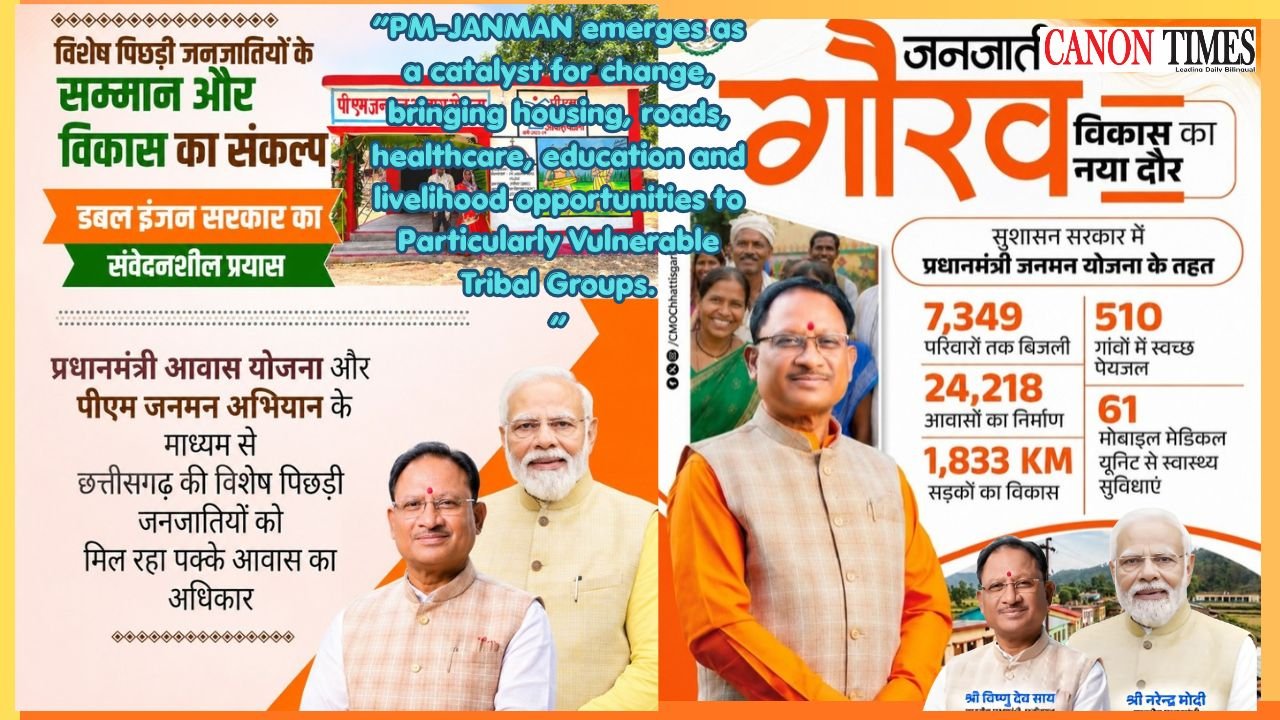
PM-JANMAN emerges as a catalyst for change, bringing housing, roads, healthcare, education and livelihood opportunities to Particularly Vulnerable Tribal Groups.
The true measure of development is not how rapidly cities grow, but how effectively progress reaches the people living in the most remote corners of the country. In this regard, the changing landscape of Chhattisgarh’s tribal regions reflects an important shift in India’s approach to inclusive development. For generations, several tribal communities living in the state’s dense forests and inaccessible settlements remained deprived of basic facilities. Today, focused government interventions are gradually changing this reality, bringing new hope to communities that have long remained outside the mainstream of development.
The transformation is being driven by the Pradhan Mantri Janjati Adivasi Nyaya Maha Abhiyaan (PM-JANMAN), launched by Prime Minister Narendra Modi in November 2023. The initiative is specifically designed to improve the living conditions of Particularly Vulnerable Tribal Groups (PVTGs) by ensuring access to housing, drinking water, electricity, healthcare, education, road connectivity and sustainable livelihood opportunities. In Chhattisgarh, the scheme has gained momentum under the leadership of Chief Minister Vishnu Deo Sai, with particular attention being given to the Baiga, Pahari Korwa, Birhor, Kamar and Abujhmadia communities.
What makes this initiative significant is its emphasis on reaching the unreached. Development is meaningful only when the benefits of governance extend beyond administrative centres and reach the last household in the remotest village. For tribal families who once had to walk several kilometres to access healthcare, education or markets, even a basic road or electricity connection can bring a fundamental change in everyday life.
The progress in housing and road infrastructure reflects this change. Against 34,691 houses sanctioned for eligible tribal families, 24,218 houses have been completed. Similarly, out of 2,901 kilometres of roads sanctioned, 1,833 kilometres have been constructed. These figures represent more than physical infrastructure. A permanent home offers security and dignity, while an all-weather road can connect an isolated village with education, healthcare, employment and economic opportunities.
Access to electricity and safe drinking water is equally important. The completion of off-grid electrification for 7,349 households is a significant step towards improving living conditions in remote settlements. In addition, 940 out of 1,490 targeted villages have achieved complete coverage under the identified electrification interventions, while 510 out of 1,425 targeted villages have achieved complete coverage in drinking water interventions. Such improvements can reduce the everyday hardships faced by tribal households, particularly women and children.
Healthcare and nutrition must remain at the centre of this development journey. Remote tribal communities often face challenges related to maternal health, malnutrition, anaemia and sickle cell disease. The operation of 61 mobile medical units and all 191 sanctioned Anganwadi centres represents an important effort to take essential services closer to people. Regular health screening, nutritional support, maternal care and awareness programmes can help address problems that cannot be solved through infrastructure alone.
Economic empowerment is another crucial dimension. Tribal communities possess valuable traditional knowledge and depend significantly on agriculture and minor forest produce such as mahua, honey, tendu leaves and medicinal herbs. Strengthening these traditional livelihoods through value addition, skill development and better market access can improve household incomes while protecting indigenous knowledge. The establishment of 16 Van Dhan Vikas Kendras is a step in this direction.
Digital connectivity is also emerging as an important instrument of inclusion. With 135 mobile tower sites sanctioned, work having commenced at 37 sites, and 51 multipurpose centres and 40 hostels being developed, remote communities are gradually moving closer to the digital world. Better connectivity can open doors to online education, digital banking, direct benefit transfers, government services and new market opportunities.
Chhattisgarh’s performance in implementing PM-JANMAN has received national recognition, with the state being honoured with the first prize by President Droupadi Murmu. This recognition is encouraging, but the larger responsibility lies in sustaining the momentum and ensuring that the benefits of these initiatives reach every eligible family.
There is, however, an important consideration that must guide this development process. Tribal empowerment should not be measured merely through the number of houses constructed, roads completed or facilities established. The real measure of success will be whether these facilities function effectively, whether children receive quality education, whether families have reliable healthcare, and whether young people can secure sustainable livelihoods. Development must also respect tribal identity, culture, traditions and community rights.
As the nation observes Janjatiya Gaurav Divas on November 15, Chhattisgarh’s efforts offer an opportunity to reflect on the broader meaning of inclusive growth. The objective should not simply be to bring tribal communities into the mainstream, but to ensure that they participate in development with dignity, equality and confidence while preserving their distinctive cultural heritage.
The journey of transformation in Chhattisgarh demonstrates that determined governance, effective implementation and community participation can make a meaningful difference. The ultimate success of PM-JANMAN will be achieved when no tribal settlement remains isolated from essential services and no family is deprived of opportunities because of its geographical location.
A developed Chhattisgarh will truly emerge when the light of progress reaches every home in its forests, every village in its hills and every family that has waited for development for generations.

Author: This news is edited by: Abhishek Verma, (Editor, CANON TIMES)
Authentic news.