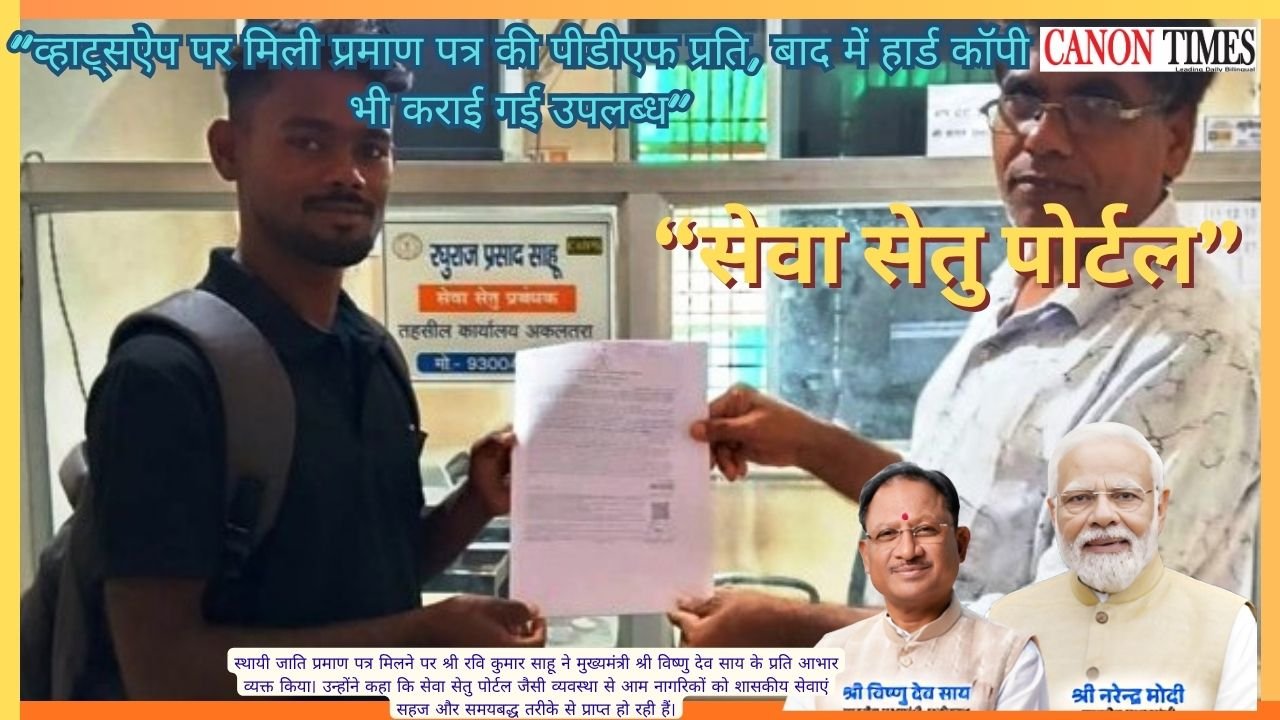
Ravi Kumar Sahu’s caste certificate, delivered within ten days through the Seva Setu portal, illustrates the promise of technology in reducing the everyday burden of government procedures.
For many citizens, obtaining a government certificate can mean repeated visits to offices, long queues and uncertainty over when an application will be processed. Digital platforms have the potential to change this experience by making public services more accessible, transparent and time-bound. The case of Ravi Kumar Sahu, a resident of Amora village in Chhattisgarh’s Janjgir-Champa district, offers a practical example.
Sahu applied for income, residence and caste certificates through the Seva Setu centre at the Akaltara tehsil office. His permanent caste certificate was issued within ten days. More significantly, a PDF copy was sent directly to him through WhatsApp, followed by the delivery of a hard copy. This allowed him to receive the document without making additional visits simply to collect it.
The initiative reflects an important shift in the delivery of public services. Technology is most useful when it saves citizens time, reduces procedural complexity and makes essential documents available when they are needed. A caste certificate, in particular, can be necessary for accessing education, scholarships, employment opportunities and other welfare entitlements. Delays in obtaining such documents can therefore have consequences beyond administrative inconvenience.
However, the success of digital governance cannot be measured only by individual success stories or the speed of certificate delivery. The larger challenge is to ensure that the system works consistently for everyone. Application timelines should be monitored, reasons for delays communicated clearly and applicants given an effective way to track progress and raise grievances.
Equally important is digital inclusion. Many rural residents, elderly citizens and economically weaker households may lack smartphones, reliable internet access or the confidence to navigate online services. Assisted service centres must therefore remain accessible and adequately equipped. Digital delivery should expand access, not create a new barrier for those who are less familiar with technology.
The use of WhatsApp to share a certificate is convenient, but it also calls for safeguards around personal information, document authenticity and secure access. Citizens should be able to verify digital certificates easily and use them without unnecessary insistence on repeated physical copies.
Sahu’s experience demonstrates what responsive administration can achieve when technology is combined with timely service. The ultimate measure of a platform like Seva Setu will be whether every applicant, regardless of location or digital literacy, can obtain essential government documents reliably, securely and without unnecessary hardship.

Author: This news is edited by: Abhishek Verma, (Editor, CANON TIMES)
Authentic news.