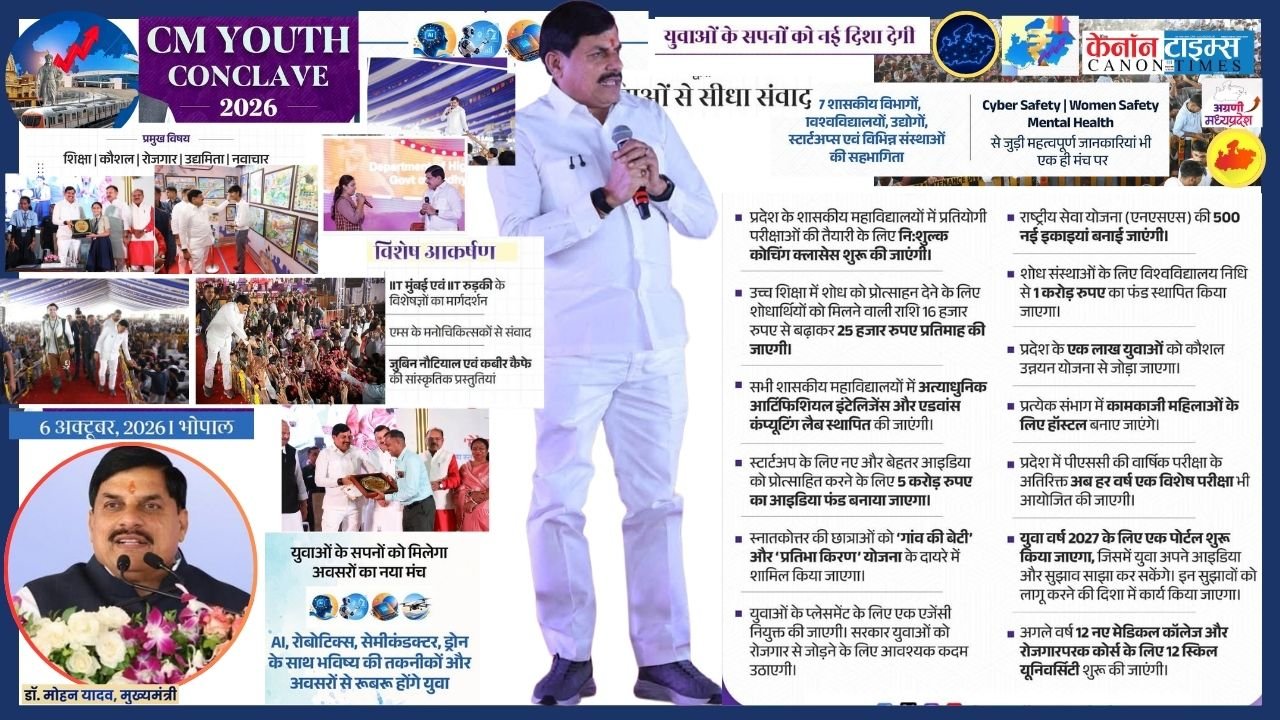
Chief Minister Dr Mohan Yadav declared 2027 as Youth Year at the CM Youth Conclave on Lal Parade Ground. He announced two MPPSC examinations in 2027 instead of one, 12 new medical colleges and 12 new universities focused on employment oriented courses. One lakh young people will be linked to skill upgradation. A dedicated portal will collect ideas from youth, with a promise to implement suitable suggestions. Free coaching for competitive exams will be provided in all government colleges. A special agency will be tasked with improving campus placements. Postgraduate girl students will be included in Gaon Ki Beti and Pratibha Kiran schemes. Advanced AI and high performance computing labs will be set up in all government colleges. Monthly fellowships for researchers will rise from 16,000 to 25,000 Rupees. A 5 crore Rupee Idea Fund will support student startups. Five hundred new NSS units will be added. Hostels for working women will be built in each division. The state will host another Global Investors Summit in 2027. The message was direct. This is your year. We will build the infrastructure. You must seize the opportunity.
This is more than a list of announcements. It is an attempt to reset the state’s social contract with its largest demographic. Madhya Pradesh is among India’s youngest states. If it can convert youth into skilled workers, innovators and job creators, the dividend is enormous. If it fails, the risk is equally large. The conclave blended policy with performance. Singer Zubin Nautiyal drew crowds. A humanoid robot named Badi walked on stage with the Chief Minister. Stalls showcased AI literacy, mental health, yoga, career guidance, Indian knowledge systems, skill upgradation, AYUSH and entrepreneurship. The energy was real. The test is whether it translates into outcomes.
Why it matters
Young people do not need only inspiration. They need pathways. Two PSC exams a year reduce the waiting time that derails careers. More medical seats expand access to a high demand profession. Employment focused universities can align curricula with industry needs if governance is tight. Free coaching lowers the barrier for first generation learners. Placement agencies can bridge the gap between degrees and jobs if they are accountable for results, not just MoUs. Higher fellowships make research viable for those without family support. An Idea Fund can turn campus projects into prototypes if disbursement is fast and mentorship is strong. Hostels for working women address a practical constraint that keeps many out of the labour force. Together, these moves aim to make the state a place where ambition can find a foothold.
The real test
Announcements are easy. Execution is hard. Will the two PSC cycles actually happen on time, with transparent processes and quick results. Will new medical colleges and universities be staffed, equipped and accredited, not just inaugurated. Will the skill upgradation programme lead to recognised certifications and actual job offers, not just attendance certificates. Will the placement agency be measured by employment rates and salary levels, with public dashboards. Will AI labs be maintained and used for real projects, not left as showpieces. Will the Idea Fund reach student teams without bureaucratic delay, with clear milestones and follow on support. Will hostels be safe, affordable and located near work hubs. And will the drug free promise by 2029 be backed by enforcement, treatment and prevention, not only rhetoric.
For students, the gain must be tangible. A coaching seat. A lab that works. A fellowship that arrives on time. A startup grant that does not stall. A job offer before graduation. That is the true measure of Youth Year: not the number of stalls at the conclave, but the number of lives that change because the state kept its word.

Author: This news is edited by: Abhishek Verma, (Editor, CANON TIMES)
Authentic news.