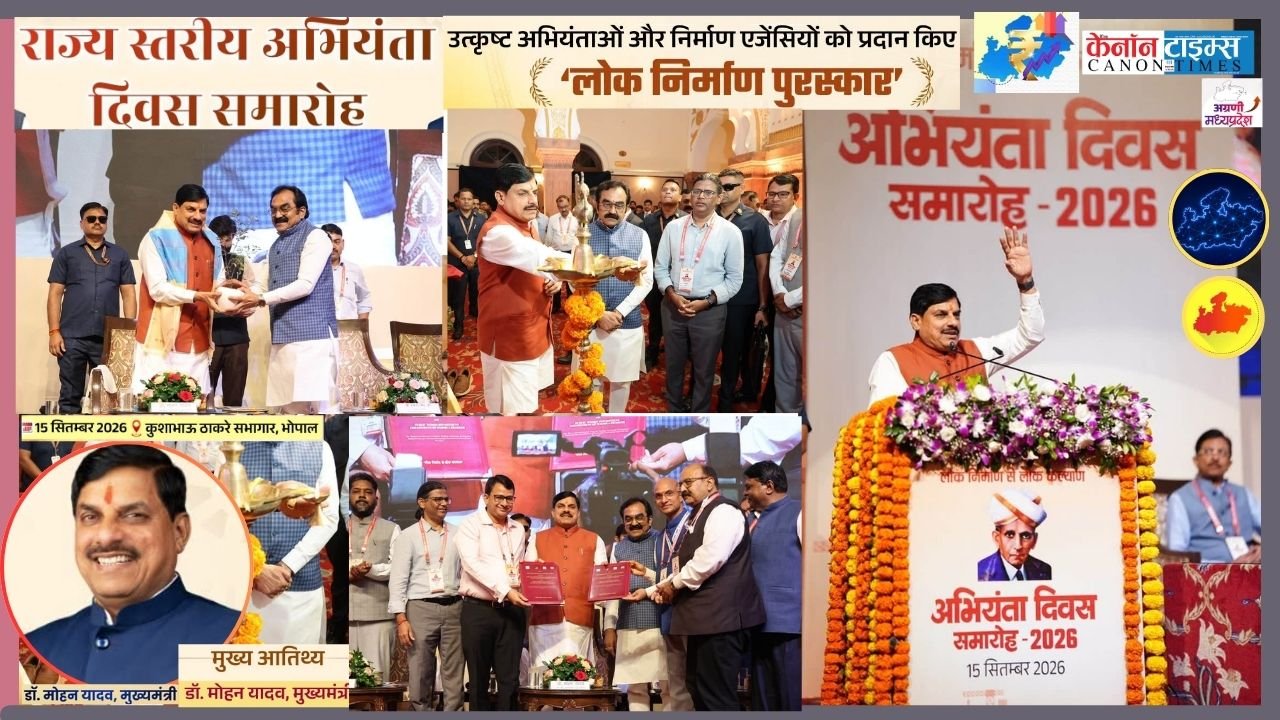
Chief Minister Dr Mohan Yadav said India’s ancient architecture still inspires new experiments with modern technology. Engineers, he added, turn vision into roads, bridges, buildings and water systems that shape the economy for generations. At the state level Engineers Day event, he honoured outstanding engineers, officials, joint teams and construction agencies across five categories. He also released a compendium of Public Works Department circulars from the last decade and signed an MoU with CSIR AMPRI for sustainable infrastructure. The message was clear. Build with quality, innovate without fear and link every project to public welfare.
The awards carry weight because they tie names to values. The Mokshagundam Visvesvaraya Award recognises technical excellence and public service. The Vishwakarma Award honours construction quality and delivery. The Vikramaditya Award rewards governance and teamwork. The Rani Durgavati Environment Friendly Award pushes for green practices. The Raja Bhoj Award celebrates design and public interest. By naming prizes after historical figures, the department connects today’s work to a longer tradition of craft, care and community benefit. It also signals that performance will be measured not just by completion, but by durability, safety and environmental stewardship.
Why does this matter. Infrastructure is the skeleton of development. A road reduces travel time and transport cost. A bridge opens markets and schools. A building provides space for learning, healing and administration. When these are built well, they last. When they are built poorly, they drain budgets and endanger lives. Madhya Pradesh is betting on a culture of research, discipline and perfection. Over 85 percent of PWD engineers received training at four leading engineering institutes in nine months. A blueprint for an Engineering Training and Research Institute is ready. Cement free concrete and green building technology are being introduced. The department says other states have adopted several of its innovations. MPRDC aims to execute work worth about 2 lakh crore rupees in the next year.
The real test will be execution at scale and safety on the ground. Will black spots on highways be identified and fixed fast enough to cut accidents further. Will contracts reward quality and penalise shortcuts without delay. Will environmental safeguards be enforced, not just written into reports. Will training translate into better site practices, from material testing to drainage design. And will the most vulnerable users, from cyclists to pedestrians, be considered in every plan. If these pieces fall into place, the state’s infrastructure will do more than move vehicles. It will move people toward opportunity with less risk and lower cost.
For engineers, the day is both recognition and responsibility. Their drawings become the state’s future. Their choices determine whether a road survives the next monsoon or a school stays cool in summer heat. That is the true measure of this push: not just the awards given, but the accidents avoided, the time saved and the trust earned.

Author: This news is edited by: Abhishek Verma, (Editor, CANON TIMES)
Authentic news.