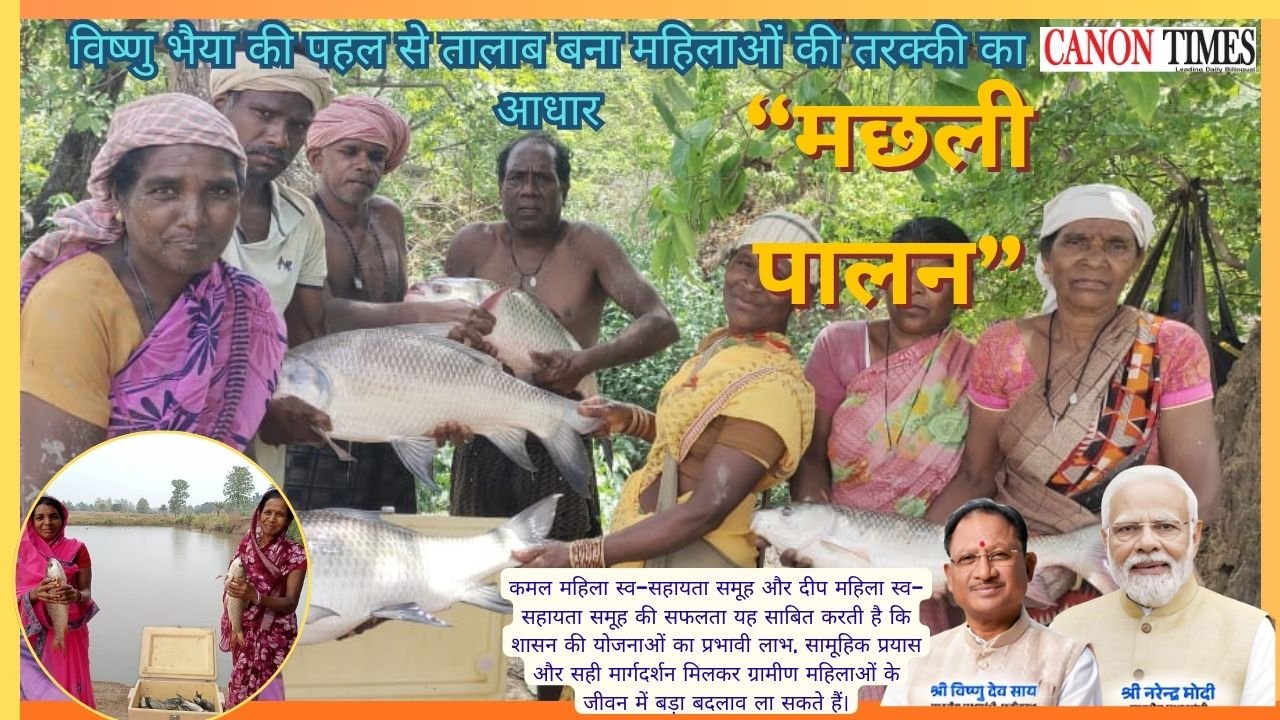
In Bhabhri village of Manora block, Jashpur district, the Kamal Women Self Help Group has turned a 0.7 hectare government pond into a steady source of income. Over the last three years, the women have practiced fish farming under a ten year lease, producing about 3 quintals of fish annually and generating sales of around 6 lakh rupees a year. In Simra village of Duldula block, the Deep Women Self Help Group is doing the same on a 0.8 hectare pond, producing about 3.3 quintals and earning nearly 6.93 lakh rupees a year. For these women, the pond is no longer just water. It is a livelihood, a classroom and a statement of agency.
This is what happens when policy meets collective action. The state provided long term leases on government ponds, technical guidance from the fisheries department and a framework for self help groups to operate as enterprises. The women brought labour, coordination and persistence. The result is income that changes household dynamics. School fees, health costs and daily expenses are no longer a source of constant anxiety. Decisions that were once made by others are now made by the women who earn the money.

Why does this model work. Fish farming is scalable, market linked and suitable for group management. A pond can be stocked, monitored and harvested on a cycle that produces regular cash flow. When women work together, they share risk, pool resources and negotiate better prices. The technical support ensures that stocking density, feed and disease management are handled properly, reducing losses. The lease model gives security of tenure, which encourages investment in the pond and in skills.
The impact goes beyond income. Women who earn are more likely to invest in their children’s education and nutrition. They gain confidence to speak in village meetings, to access banks and to plan for expansion. In Bhabhri and Simra, the success of the Kamal and Deep groups has become a reference point for other women. The message is simple. If a pond can be turned into a business, other common resources can be too.
The state’s role must now be to deepen and widen this success. More ponds should be leased to women’s groups with clear terms and timely renewals. Training must be continuous, not just at the start. Cold chain and market linkages should be strengthened so that produce reaches buyers quickly and at fair prices. Credit must be accessible for inputs and expansion. And environmental safeguards must be in place to ensure that water quality and local ecology are protected.
Chief Minister Vishnu Deo Sai, called “Vishnu Bhaiya” by many beneficiaries, has positioned this as part of a broader push for women’s economic empowerment. The numbers from Jashpur show that the approach is working. But the real test is sustainability. Can these groups maintain yields over time. Can they move up the value chain, into processing or branding. Can they mentor new groups and create a local ecosystem of aquaculture enterprises.
The story of Bhabhri and Simra is not just about fish. It is about how a common resource, when managed by women with the right support, can become a foundation for self reliance. A pond that once sat idle now feeds families, funds education and builds confidence. That is the true measure of a livelihood scheme: not just the money it generates, but the dignity it creates.

Author: This news is edited by: Abhishek Verma, (Editor, CANON TIMES)
Authentic news.