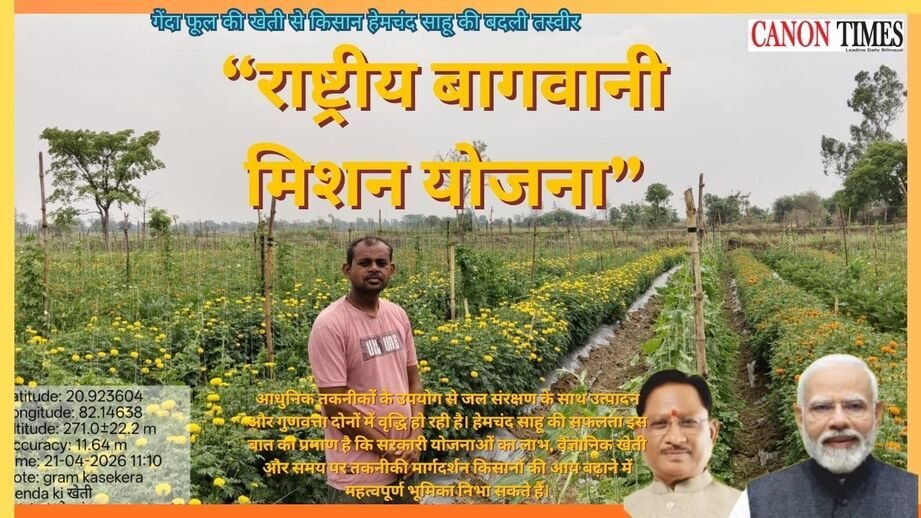
For many farmers, the biggest challenge is not cultivation, but low and uncertain income from traditional crops. Hemchand Sahu of Kasekera village in Chhura block has shown that with the right crop choice and modern techniques, even a small landholding can become a source of meaningful prosperity.
By shifting from conventional paddy cultivation to marigold farming on 0.48 hectares, and by adopting drip irrigation and mulching under the National Horticulture Mission, Sahu has significantly improved both productivity and income. With guidance from horticulture officials and the use of scientific farming methods, he not only controlled costs but also raised the quality of his produce. His flowers were sold in local markets as well as in Raipur, earning him a net profit of about two lakh Rupees.

Sahu’s success is important because it reflects a larger reality. Farmers do not always need more land to earn more; often, they need better technology, proper guidance, and access to markets. Marigold cultivation has given him financial stability, and his example is now encouraging nearby farmers to consider commercial flower farming as a viable option.
This is exactly the kind of change agriculture needs. In a time when water conservation, cost control, and higher returns are all critical, crop diversification can offer farmers a stronger future. Hemchand Sahu’s journey proves that when government support and scientific farming come together, rural livelihoods can be transformed in a sustainable way.

Author: This news is edited by: Abhishek Verma, (Editor, CANON TIMES)
Authentic news.