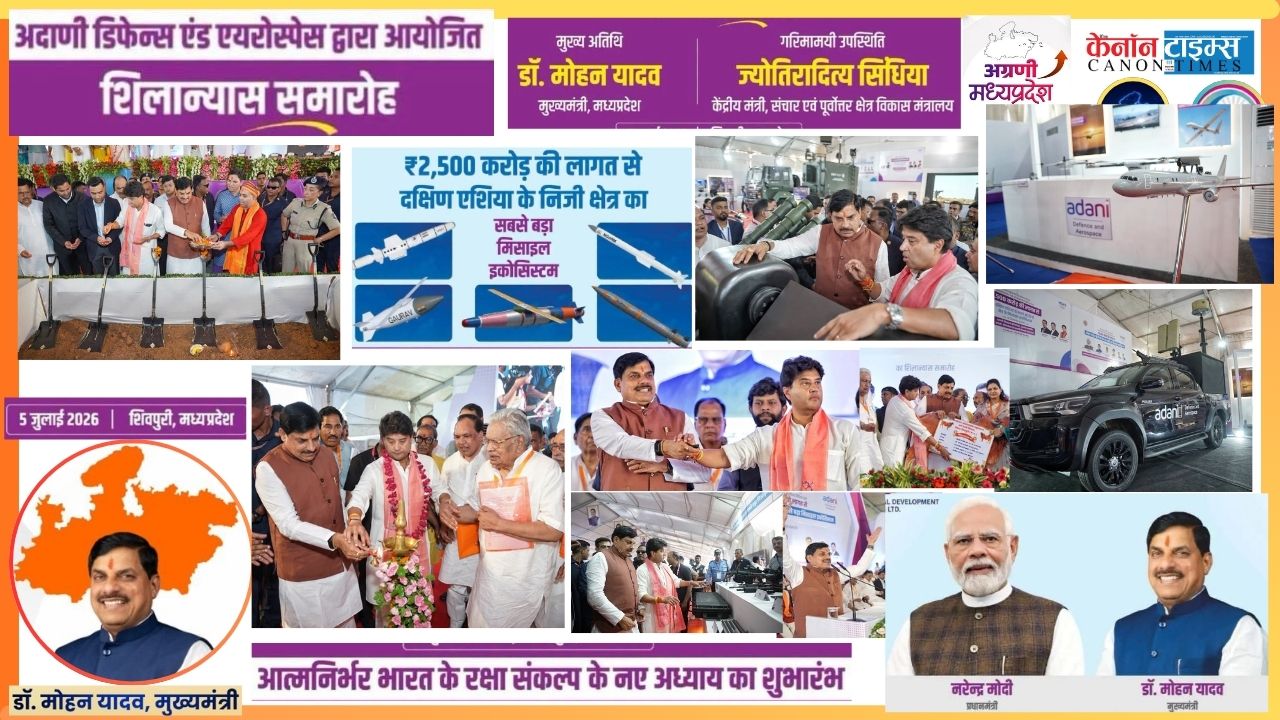
Shivpuri’s new defence and aerospace manufacturing project marks a significant shift in how Madhya Pradesh is positioning itself in the national growth story. The proposed Adani facility is not just another industrial investment. It represents the growing confidence that India can build, manufacture and export advanced defence products from within its own borders. That is a strong symbol of self-reliance, and Shivpuri now finds itself at the centre of that aspiration.
The larger significance of this project lies in the changing nature of India’s defence sector. A country that once depended heavily on imports is now emerging as a producer and exporter of defence equipment. That transition has strategic as well as economic value. It strengthens national security, reduces external dependence and creates a domestic manufacturing ecosystem that can support innovation, supply chains and skilled employment. In that sense, the Shivpuri plant is more than a factory. It is part of a national capability shift.

For the Gwalior-Chambal region, the project could be transformative. Large industrial investments of this kind create direct jobs, but their deeper impact comes through indirect opportunities in logistics, fabrication, transport, maintenance and local vendor networks. If the plant operates as planned, thousands of young people may find work either directly or through related industries. That can change the economic character of an entire region, especially one that has long waited for large-scale industrial momentum.
The government’s effort to pair this industrial announcement with local infrastructure promises is also important. Roads, colleges, hospitals, water access, a new tehsil and tourism development all suggest an attempt to build Shivpuri not only as an industrial point but as a more complete urban centre. That matters because investment succeeds best where workers and families can actually live well. Industry needs not just land and policy, but schools, healthcare, transport and civic amenities. The announced projects, if delivered, could help create that supporting environment.
The promise of a four-lane circular road is especially practical, as is the proposed children’s hospital and expanded healthcare support in the wider region. Industrial growth often falters when urban pressure outpaces civic infrastructure. By linking industrial expansion with mobility and social services, the state is at least trying to prevent that imbalance. The same logic applies to the proposed tourism centre and Shiv statue, which could help diversify the city’s economy beyond manufacturing alone.
There is also an important political message here. The combination of state leadership, central support and private capital is being presented as the model for development. That formula can work if it remains transparent, accountable and focused on outcomes. Mega announcements generate optimism, but real credibility comes from execution: completed works, functioning plants, trained workers and visible benefits for local residents. The true test will be how much of this promise reaches the ground over the next few years.
Shivpuri’s place in the defence production map may still be new, but its symbolic importance is already clear. If the project is implemented well, it could help turn a district once known mainly for geography and heritage into a major industrial node in India’s self-reliant future. That would be a meaningful achievement not just for Shivpuri, but for the broader idea of a stronger, more capable and more confident India.

Author: This news is edited by: Abhishek Verma, (Editor, CANON TIMES)
Authentic news.