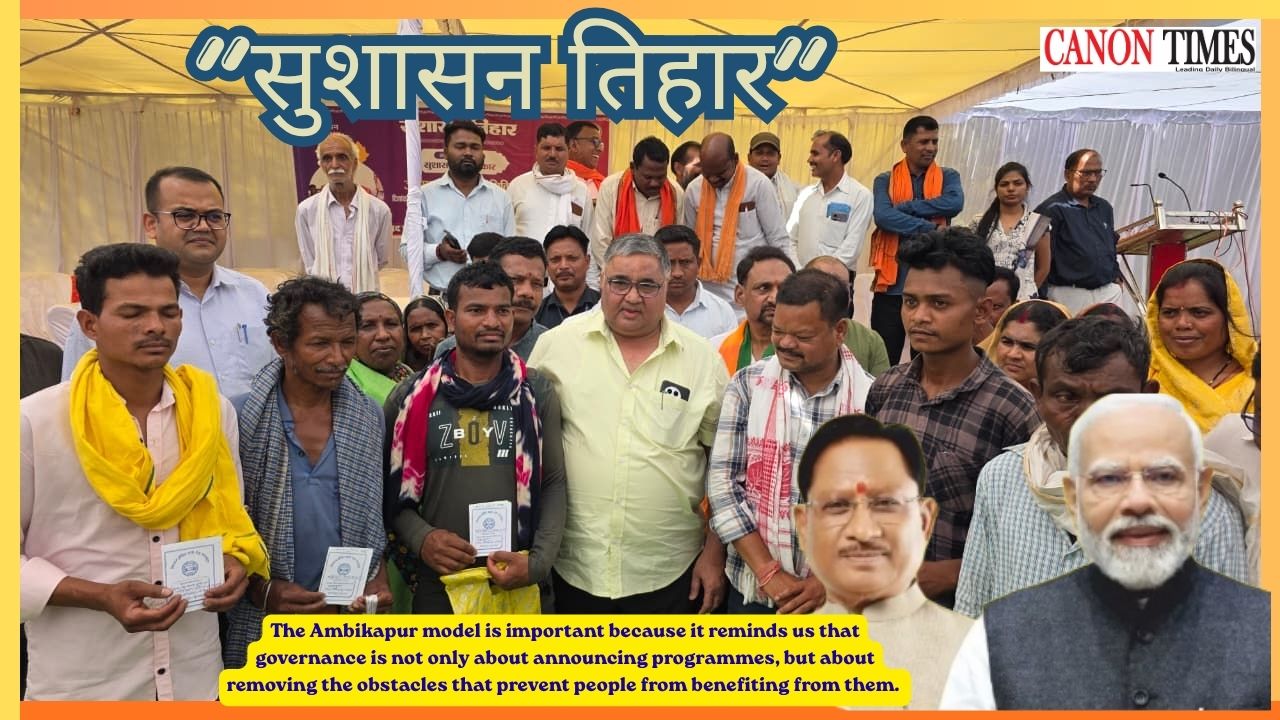
Ambikapur’s experience during Sujhaasan Tihar offers a useful lesson in public administration: government is most credible when it resolves ordinary people’s problems quickly and completely.
The Agriculture Department’s reported 100 percent disposal of 200 farmer applications may look like a local administrative achievement, but it reflects something much larger. It shows that schemes such as PM Kisan Samman Nidhi and Kisan Samruddhi succeed only when the machinery of the state responds with speed, sensitivity and accountability.
The nature of the complaints is telling. Farmers were not asking for abstract promises; they were seeking corrections in registration, Aadhaar linking, bank account details, name mismatches and eligibility issues. These are small technical errors on paper, but for a cultivator they can mean delayed payments, missed support and avoidable frustration.

When a department verifies documents, tracks each case and follows through until the last application is resolved, it turns a welfare programme into a working service.
This is where governance becomes visible to the public. Many schemes fail not because the policy is weak, but because implementation is slow or fragmented. Ambikapur’s response suggests that district level supervision, special camps and direct monitoring can remove bottlenecks that usually keep benefits from reaching farmers. That matters especially in rural areas, where one unresolved data error can block support for an entire season.
The broader significance is political as well as administrative. Farmers judge the state not by the language of circulars but by whether money reaches their accounts and their paperwork is corrected without repeated visits. By ensuring that every application received during the campaign was examined and resolved, the district administration strengthened trust in public institutions. That trust is essential if welfare schemes are to remain credible and widely used.
Still, such success should not remain event driven. The real challenge is to make grievance redressal routine, not seasonal. Every district should have a permanent system for resolving errors in farmer databases, beneficiary lists and bank linkage issues. Digital systems need local support desks, field verification and clear timelines. Public outreach must also continue so that farmers know where to go and whom to contact when a scheme problem arises.
The Ambikapur model is important because it reminds us that governance is not only about announcing programmes, but about removing the obstacles that prevent people from benefiting from them. When a department treats each application seriously and finishes the job, the result is more than administrative order. It is a stronger relationship between the state and the citizen, built on reliability rather than rhetoric. That is the true meaning of good governance.

Author: This news is edited by: Abhishek Verma, (Editor, CANON TIMES)
Authentic news.