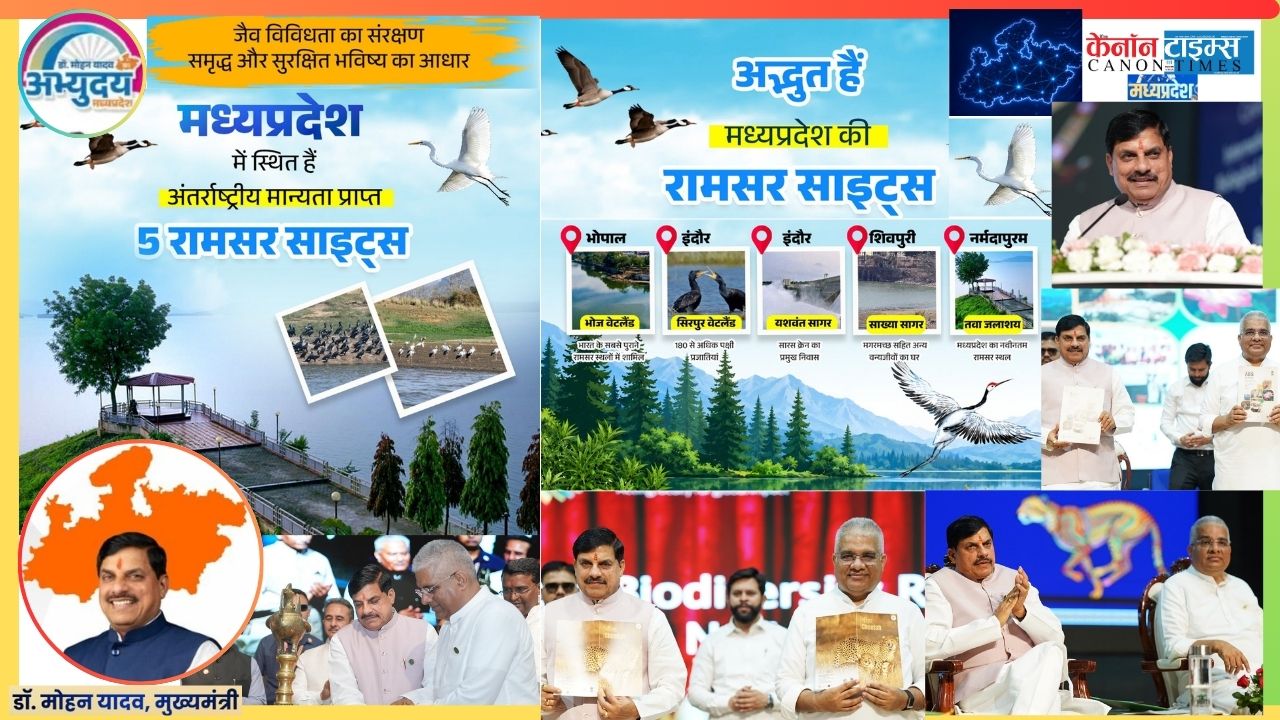
India’s growing commitment to environmental protection and biodiversity conservation is finding a remarkable example in Madhya Pradesh. The state has steadily transformed itself into one of the country’s strongest centers for wildlife conservation, ecological restoration, and sustainable environmental management. Recent initiatives highlighted during the International Day for Biological Diversity celebrations at the Indian Institute of Forest Management (IIFM), Bhopal, demonstrate how Madhya Pradesh is not only preserving its natural heritage but also creating a globally recognized conservation model.
Chief Minister Dr. Mohan Yadav’s assertion that Madhya Pradesh has become a “Cheetah State,” alongside being recognized as a “Tiger State,” “Leopard State,” “Vulture State,” and “Gharial State,” reflects the scale of the state’s biodiversity achievements. The successful reintroduction of cheetahs, once declared extinct in India, stands as one of the most ambitious wildlife restoration projects in the world. The revival of cheetah populations in Kuno National Park and Gandhi Sagar Sanctuary is more than a symbolic victory. It represents India’s renewed ecological confidence and scientific capability in wildlife management.

The success of Project Cheetah is particularly significant because it demonstrates that conservation is possible when political will, scientific planning, and community participation work together. With 53 cheetahs currently in the state, including several born on Indian soil, Madhya Pradesh has become an international case study in species reintroduction and habitat management.
Equally important is the state’s broader approach toward ecological conservation. The restoration of wetlands, rejuvenation of rivers, protection of grasslands, and conservation of endangered species such as vultures, gharials, and wild buffaloes indicate that biodiversity protection is being treated as an interconnected environmental mission rather than an isolated wildlife agenda.
The government’s “Jal Ganga Sanvardhan Abhiyan” further strengthens this vision by linking water conservation with ecological sustainability. The restoration of thousands of water bodies, stepwells, ponds, and rivers shows a recognition that healthy ecosystems are impossible without healthy water resources. Such integrated thinking is essential in an era marked by climate change, water scarcity, and habitat degradation.
Another encouraging aspect is the emphasis on public awareness and local participation. Initiatives like the “Cheeta Mitra” program and biodiversity awareness campaigns are helping communities become stakeholders in conservation. This is critical because long-term environmental protection cannot succeed through government intervention alone. Local communities must feel connected to forests, wildlife, and natural resources.
The event at IIFM also highlighted India’s broader environmental leadership. Union Environment Minister Bhupender Yadav emphasized that biodiversity is not merely an ecological concern but the foundation of Indian civilization itself. His remarks underscored the need for balancing economic growth with environmental sustainability. India’s progress in reducing carbon emissions, expanding Ramsar sites, and promoting sustainable development reflects an emerging global leadership role in climate and biodiversity action.
However, conservation success also brings new challenges. Growing wildlife populations require larger and better-connected habitats. Human-wildlife conflict, illegal encroachment, climate pressures, and developmental expansion remain serious concerns. Maintaining ecological balance will require continuous scientific monitoring, stronger institutional coordination, and long-term policy consistency.
Madhya Pradesh’s achievements prove that conservation and development are not opposing goals. Sustainable environmental practices can coexist with economic progress when governments prioritize ecological planning. The state’s efforts to establish wildlife rescue centers near forests and national parks, improve habitat restoration, and strengthen biodiversity management indicate a forward-looking approach.
At a time when environmental crises dominate global discussions, Madhya Pradesh offers a hopeful narrative. Its biodiversity initiatives show that with commitment, innovation, and public participation, environmental restoration is achievable. The state’s evolving conservation model deserves national and international attention, not only as a success story in wildlife protection but also as a roadmap for sustainable development in the 21st century.

Author: This news is edited by: Abhishek Verma, (Editor, CANON TIMES)
Authentic news.