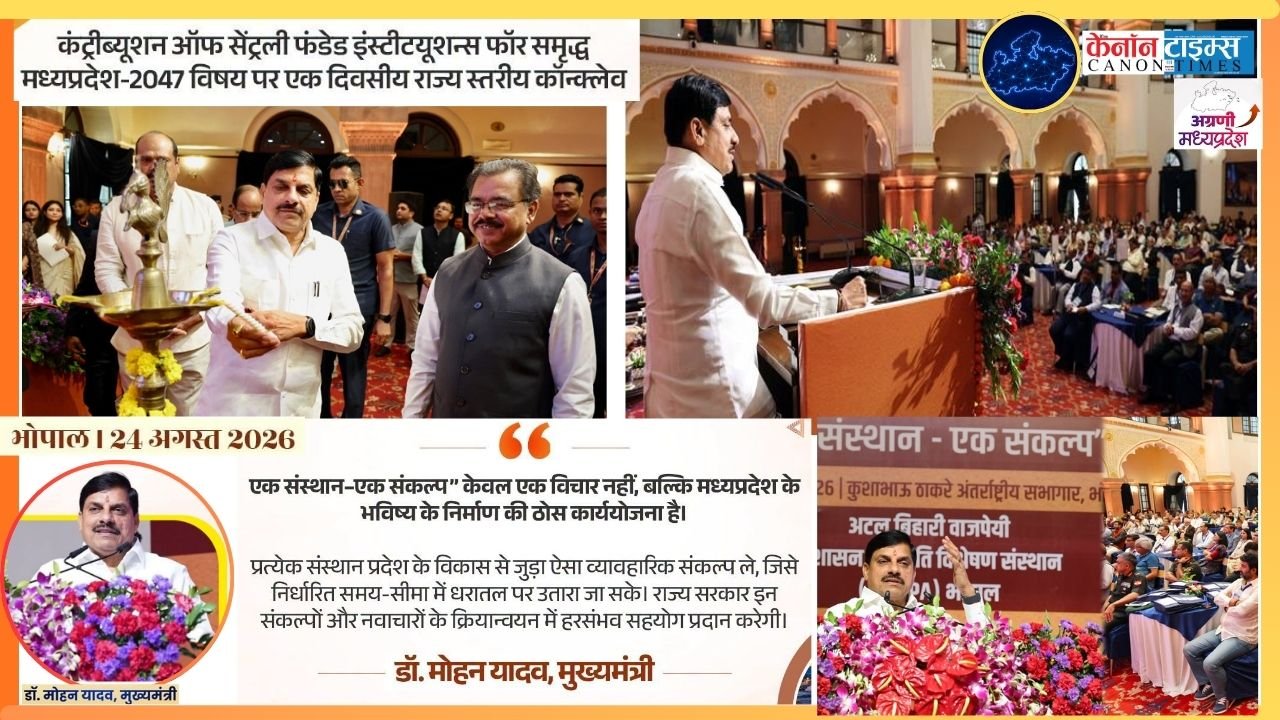
Skills are the new currency. Innovation is the new economy. That was the core message from Chief Minister Dr Mohan Yadav at a state level conclave of centrally funded institutions in Bhopal. The theme was clear: One Institution, One Promise. The goal is even clearer: Samriddh Madhya Pradesh @ 2047. The state has abundant resources, a young population and a growing industrial base. The question now is how to turn these advantages into sustained, knowledge led growth.
The conclave brought together more than 60 institutions, including IIT Indore, IISER Bhopal, NID Bhopal, LNIPPE Gwalior, ABV IIITM Gwalior, IIIT Bhopal, CSIR AMPRI, SPA Bhopal, NFSU Bhopal and ICAR’s National Soybean Research Institute, among others. Thirteen memorandums of understanding were signed to strengthen education, research, skill development and innovation across the state. A knowledge depository portal is also set to be launched so that institutions can share ideas and track progress. This is not just a meeting. It is a compact between the state and its knowledge ecosystem.
Dr Yadav’s analogy was striking. Just as Jamvant reminded Hanuman of his latent strength before the leap across the ocean, Prime Minister Narendra Modi has reminded India of its own capabilities. The task for Madhya Pradesh is to convert that confidence into outcomes. That means moving from publications to patents, from patents to prototypes, and from prototypes to enterprises that create jobs and add value. It also means ensuring that research solves real problems faced by farmers, small businesses and urban communities, not just those that look good on a slide.
The emphasis on skills is timely. Artificial intelligence, cybersecurity, drone technology, semiconductor design and smart village planning were among the areas discussed by representatives. These are not abstract fields. They are the sectors that will define employability in the next decade. If the state aligns its training and research with these needs, it can create a pipeline of talent that attracts investment and supports local entrepreneurship. The presence of sports, physical education and home stay training in the agenda also shows an understanding that the future economy is diverse. Tourism, culture and wellness can be as much a part of growth as technology and manufacturing.
What will determine success is execution. The One Institution, One Promise idea must translate into time bound commitments with measurable results. Each institution should adopt a practical pledge linked to the state’s priorities: higher crop productivity through better seeds and soil health, cleaner energy through renewables, safer cities through forensic and cyber capabilities, better design for local products, and stronger teacher training for schools and colleges. The state government has promised full support. That support must include fast clearances, shared infrastructure, data access and outcome based funding.
Chief Secretary Ashok Barnwal’s reminder was sobering. The next generation will judge this generation by what it leaves behind. A vision document is only as good as the actions it triggers. If Madhya Pradesh wants to be a global leader in any sector, it must set big goals and deliver quality results. That requires coordination between government, industry, civil society and citizens. It also requires a culture that rewards risk taking, tolerates failure and learns quickly.
The water dialogue with Rajasthan shows that even complex, long standing issues can move forward with clear vision and collective will. The same spirit must guide the 2047 mission. If institutions, industry and government work together with discipline, Madhya Pradesh can become a model of knowledge based development. The conclave has set the direction. The real test begins now, in labs, fields, factories and classrooms across the state.

Author: This news is edited by: Abhishek Verma, (Editor, CANON TIMES)
Authentic news.