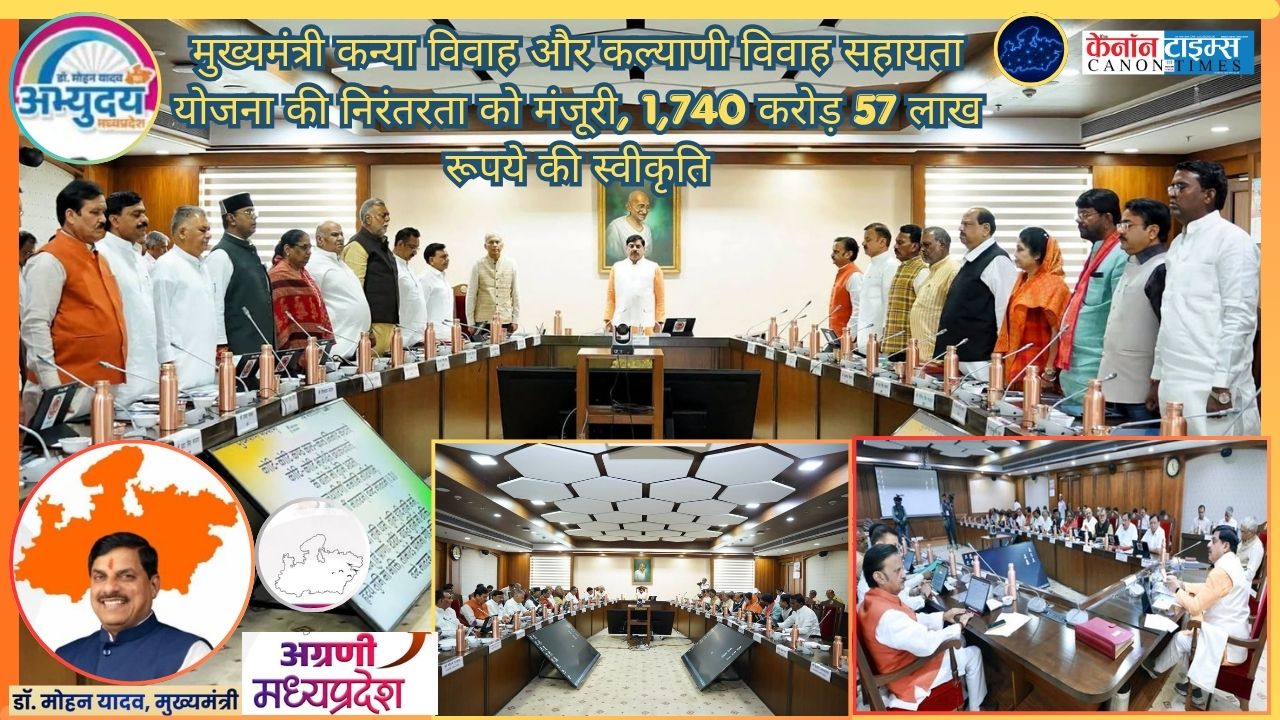
The recent cabinet meeting under Chief Minister Dr. Mohan Yadav approved an ambitious package of schemes worth Rs 5,960 crore that range from social welfare continuations to education upgrades and farmer relief.
At a glance the package blends headline investments with granular measures that matter to ordinary citizens: sustained support for girls marriages and widow assistance, the ambitious upgrading of hundreds of schools, zero interest short term crop loans, and the founding of a new government law college in Shujalpur. The coherence of the choices matters.

They show a government that is not only committing funds but attempting to address the multiple dimensions of social inclusion, human capital and rural resilience.
The decision to extend the Chief Minister Kanya Vivah and Kalyani Vivah assistance for another five years is clearly social policy with a purpose. Beyond immediate financial aid the programme reinforces legal marriage age norms, reduces economic barriers to marriage for vulnerable families and signals continuing state support for women s social security.
Its real value will come when these cash transfers are accompanied by complementary measures that expand education and livelihood opportunities for girls so that assistance becomes a stepping stone to agency rather than only a short term relief.
The education upgrades are significant in scale and intent. The theoretical approval to elevate 225 secondary schools to high school status and 300 high schools to higher secondary over three years confronts one of the persistent bottlenecks in learning access the distance and availability of schools beyond the basic grades. If executed well this will reduce dropout rates at crucial transition points and improve gross enrolment ratios. Success will require careful local mapping, timely infrastructure investment, teacher recruitment and training, and systems to ensure upgraded institutions are fully functional rather than nominally reclassified.
On farmer welfare the cabinet s approval of short term crop loans at zero percent interest addresses a genuine rural grievance the cost of seasonal finance. Simplifying rules and providing an annual single loan limit with incentives for timely repayment reduces the administrative complexity that often deters smallholders. However, interest subsidies must be paired with stronger credit discipline, transparent eligibility, and support to prevent moral hazard. Above all they must be complemented by improved extension services and market linkages so that cheaper credit actually funds productivity enhancing inputs rather than consumption alone.
The approval to establish a new government law college in Shujalpur is a welcome addition to educational infrastructure and to regional equity. Converting existing faculties and ensuring Bar Council compliance will expand access to legal education in a part of the state that needs it. As with school upgrades, creating posts, buildings and a viable academic environment will be crucial if the new institution is to produce quality graduates rather than merely create positions.
A few implementation themes will determine whether these approvals translate into durable outcomes. First leadership and accountability at the district level will matter more than the size of allocations. Clear timelines, transparent budgets and visible progress reporting will build public confidence. Second the state must guard against perfunctory approvals by ensuring that physical investments staffing and recurrent costs are budgeted and released on schedule. Third stakeholder engagement matters: community involvement in school catchment decisions, farmer consultations on loan design, and civil society participation in social welfare rollouts will reduce friction and improve targeting.
Finally, fiscal prudence and monitoring are essential. Ambitious schemes carry recurrent costs. The state should combine capital commitments with medium term fiscal planning, and put in place measurable indicators for enrollment, loan uptake and social impact. Independent audits and grievance mechanisms will help correct course quickly.
The cabinet s package is notable for its breadth and responsiveness to pressing social needs. The real test will be in implementation. If the state follows up these approvals with disciplined execution, local empowerment and transparent monitoring then the Rs 5,960 crore cannot only fund projects but can generate lasting improvements in education, farmer security and social inclusion across Madhya Pradesh.

Author: This news is edited by: Abhishek Verma, (Editor, CANON TIMES)
Authentic news.