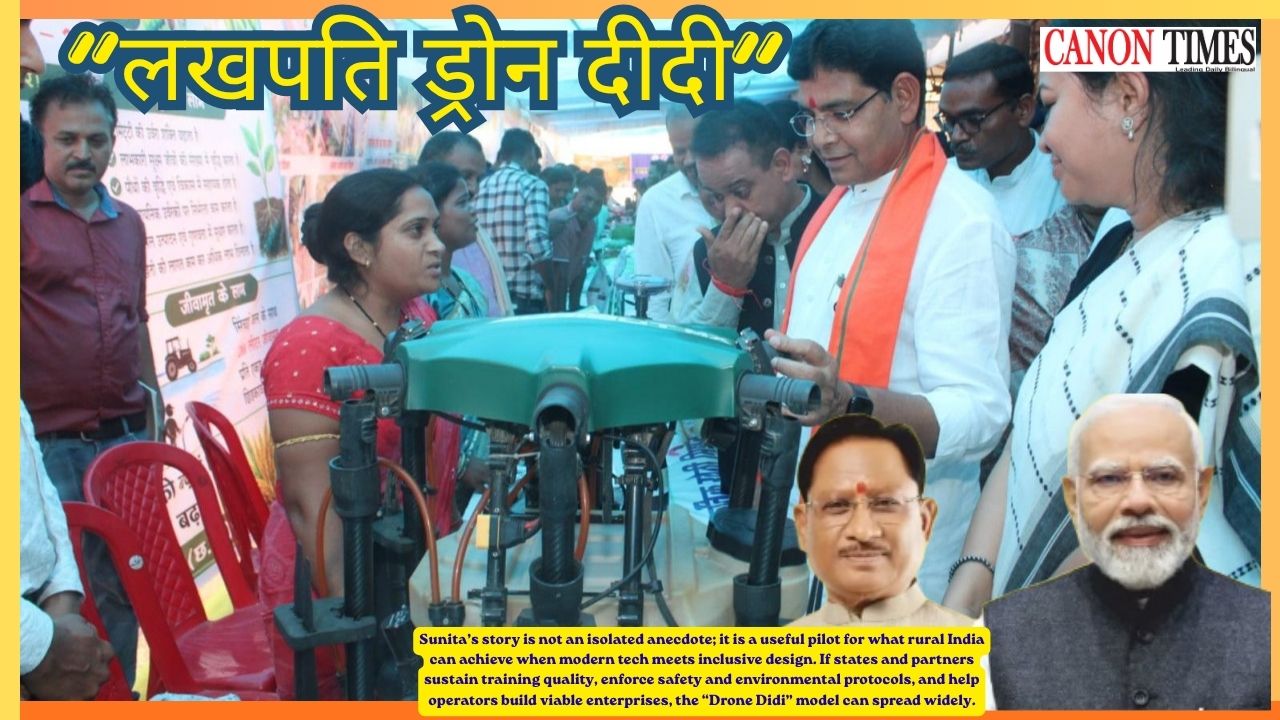
The image of Sunita Patel lifting a heavy, water‑filled drone into the sky and spraying fields with surgical precision is more than a feel good moment. It is emblematic of a larger shift in rural India where technology, targeted policy and women’s agency combine to remake livelihoods.
Sunita’s journey from Khori‑gaon to becoming a dependable drone operator earning substantive income shows how a well designed programme can convert training and equipment into dignity, cash and local respect.
The initiative’s promise is straightforward. Smallholder agriculture needs affordable, timely and precise interventions. Drones deliver them enabling rapid crop protection, judicious use of inputs and savings in time and labour. For women the dividends are especially large.
Beyond the direct income Sunita now earns, ownership of a technical skill gives social status, autonomy and a model that other women can emulate. When public subsidy, concessional finance and accessible training come together, technology ceases to be the preserve of the few and becomes a village asset.
Yet scaling this success requires steadying hands. First, quality of training and certification must be unimpeachable. Flying agricultural drones safely over populated habitations and near power lines demands rigorous RPTO training and regular refresher modules. Second, ensure safety and environmental safeguards. Protocols for accurate dosing of pesticides and nano‑fertilisers, effective buffer zones around water bodies, and monitoring of drift must be enforced to protect human health and biodiversity. Third, make business models resilient. Women operators need market linkages, group contracting through SHGs or FPOs, predictable demand calendars and transparent pricing so income is regular rather than sporadic.
Policy design can multiply the gains. Subsidy and low cost credit should be coupled with bundled support insurance for equipment, after sales service centres, and local maintenance training so downtime is minimised. Link operators to farmer producer organisations and input suppliers so drones serve as a node for both service delivery and value chain aggregation. Encourage public demonstration days and local peer‑to‑peer training so learnings cascade horizontally across villages.
There is also an important gender and social dimension. Programmes must protect women operators’ control over income and assets and guard them against undue capture by middlemen. Secure, registered ownership of equipment, simplified banking links for DBT and mentoring on enterprise management will help ensure that women retain the lion’s share of benefits.
Sunita’s story is not an isolated anecdote; it is a useful pilot for what rural India can achieve when modern tech meets inclusive design. If states and partners sustain training quality, enforce safety and environmental protocols, and help operators build viable enterprises, the “Drone Didi” model can spread widely. Then the sky will not be merely a spectacle but a sustained corridor to better incomes, cleaner input use and a more confident rural womanhood.

Author: This news is edited by: Abhishek Verma, (Editor, CANON TIMES)
Authentic news.