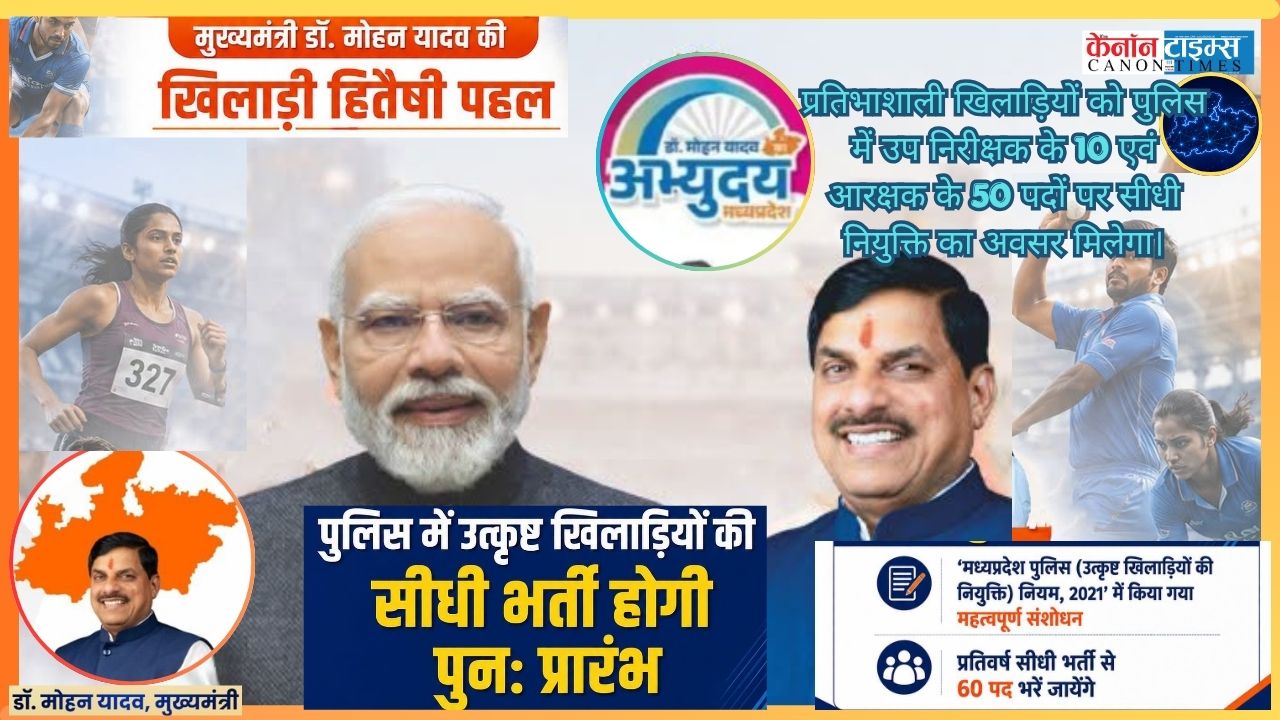
Madhya Pradesh’s decision to resume direct recruitment of outstanding athletes into the police acknowledges a simple truth: sporting excellence is public value.
Offering an annual quota of 60 direct appointments, with places for sub‑inspectors and constables, recognises that athletes invest years of discipline and sacrifice and often face insecure career horizons once competition ends.

Converting national and international sporting achievement into stable employment is not charity; it is a sensible social investment that rewards merit and encourages wider participation in sport.
The scheme’s strengths are evident. Institutionalising recruitment ends the uncertainty that talented players have long faced. Widening eligibility to include Olympians, Asian and Commonwealth participants alongside national medallists aligns selection with proven standards of elite performance.
Exempting certain educational or procedural hurdles for decorated athletes is defensible, given the distinct career trajectory of sportspeople. Making the process annual rather than ad hoc allows athletes to plan their futures with confidence.
Yet good intent will count for little unless implementation is careful. Sporting success should be an entry asset, not a substitute for policing competence. Recruits must receive rigorous, tailored induction and training that equips them with knowledge of law, procedure, ethics and community policing. Physical fitness and competitive temperament are valuable, but they cannot replace skills in investigation, rights protection and citizen interaction. Without such professional grounding, recruits risk being symbolic hires rather than effective officers.
Transparency is equally essential. Selection criteria, evaluation methods and tie breaking rules must be published and applied consistently. Independent panels that include sporting and policing experts, along with a clear grievance redress mechanism, will help prevent perceptions of favouritism and build public trust in the process. The proposed seniority rules based on level of competition and age are reasonable provided they are enforced openly.
There is also an opportunity to amplify the social return from this policy. Athlete officers should not simply be absorbed into routine duties; they can play a wider role in community outreach, youth engagement and sports promotion. Assigning them to run school fitness programmes, local coaching clinics and talent scouting initiatives will multiply the scheme’s impact by encouraging grassroots participation and nurturing future champions. Embedding athletes in physical training roles within police academies can also improve force fitness and morale.
The state should monitor outcomes closely. Tracking training completion, on duty performance and community feedback will indicate whether the recruits adapt to police roles and contribute meaningfully. Career pathways must be clear so athlete officers can progress on merit and do not stagnate in token positions. Keeping the quota modest and scalable allows the state to learn from early cohorts and refine the programme before any expansion.
When honouring champions is combined with rigorous training, transparent selection and purposeful deployment, the policy can set a national example: it will reward excellence, broaden sporting aspiration and strengthen policing with disciplined, community minded personnel. Without those guardrails, however, the initiative risks remaining a symbolic gesture rather than a durable reform. The government has taken a promising step; its task now is to make sure that step leads to lasting public value.

Author: This news is edited by: Abhishek Verma, (Editor, CANON TIMES)
Authentic news.